








Cortisol is the stress hormone, produced by the adrenal glands. Essential for survival, it regulates energy, inflammation, blood pressure, and the wake/sleep cycle.
Under normal conditions, the cortisol peak occurs in the morning (6 AM–8 AM), then gradually decreases until evening.
Chronic stress leads to excessive cortisol secretion, which depletes the adrenal glands and disrupts hormonal balance.
A prolonged excess can cause an estrogen/progesterone imbalance as well as a metabolic block: fat storage
Excess cortisol: learn more about how stress damages our health
It is no secret: a very large number of women suffer from chronic stress. It is hard to stay calm when you have so many areas of life to manage: family, professional, marital, social, personal... While stress is necessary for life, an excess causes health problems, including for hormonal health.
The main biological marker of stress is cortisol. Deficiencies in adrenal hormones (including cortisol) are increasingly common and too rarely diagnosed. Did you know? A man's adrenal glands are 50% larger than a woman's.
It is essentially the "stress hormone." A hormone produced by the adrenal glands, cortisol plays an essential role in regulating the metabolism of carbohydrates, lipids, proteins, ions, and water to prevent any sudden fluctuations in the body's physiological balance. Periods of stress that occur too regularly, known as "chronic stress," will boost cortisol secretion and exhaust the adrenal glands, impacting the proper functioning of other hormones—hence the importance of knowing how to lower your cortisol levels naturally.
First direct effect: as cortisol production weakens, progesterone (the "calming" sex hormone) will be converted into cortisol to replenish stocks, thereby disrupting the estrogen/progesterone ratio... creating a vicious circle. An excess of cortisol will eventually lead to a cortisol deficiency in the long term. This is why it is so important to better control our stress and not let it settle in.

What is cortisol? What are its effects?

The role of cortisol
In situations of occasional stress, this hormone is very beneficial: it allows us to mobilize our resources and make them available to the functions we will need most to face the "danger." Thus, our sugar and fat reserves will be recruited and directed towards the brain and muscles, including the heart muscle.
It will increase blood pressure so that these nutrients reach these essential organs for the stress response more quickly. In moderate doses and occasional release, it has an anti-inflammatory role. Cortisol is also used as a medication for this purpose in a form called cortisone or corticoids. In fact, we could not live without cortisol.
Energy regulation:
- Mobilizes glucose, proteins, and lipids to provide energy.
- Helps maintain stable blood sugar levels between meals.
Stress response:
- Activates the "fight or flight" response in stressful situations.
- Temporarily reduces non-essential functions (digestion, reproduction) to prioritize vital functions.
Inflammation management:
- Helps reduce inflammation by regulating the immune response.
- Participates in tissue healing and repair.
Blood pressure regulation:
- Contributes to maintaining adequate blood pressure by acting on blood vessels.
Circadian cycle:
- Peaks in the morning to promote wakefulness and alertness.
- Gradually decreases during the day to prepare the body for rest.
Impact on mood and cognition:
- Influences mood, memory, and concentration.
- Plays a role in resilience when facing stressful situations.
Immune system function:
- Temporarily suppresses certain immune responses to prevent excessive inflammation.
In case of excess and/or prolonged secretion (chronic stress), the effects of cortisol become harmful:
An excess of cortisol has several effects:
- Disrupts carbohydrate metabolism: cravings and weight gain.
- Decreases immune response: weakens health.
- "Stimulating" effect: disrupts sleep.
- Promotes osteoporosis and strains the heart.
- Beyond a certain threshold, becomes pro-inflammatory: pain, fatigue, degradation of the quality of the microbiota...
- Leads to a progesterone deficiency: cortisol levels can be maintained through the depletion of progesterone.
Cortisol peak
The cortisol peak refers to the time when this hormone reaches its maximum level in the blood. This phenomenon occurs naturally every day, usually early in the morning, between 6 AM and 8 AM.
During this peak, cortisol stimulates wakefulness, mobilizes energy reserves by increasing glucose levels in the blood, and prepares the body to face the demands of the day.
In a healthy individual, this peak is followed by a gradual decrease in cortisol levels throughout the day. It reaches its lowest point at night, thereby promoting rest and recovery. Factors such as chronic stress or disrupted sleep can alter the regularity or intensity of this peak.
What are the symptoms of an excess of cortisol?

The symptoms of excessive cortisol are numerous and varied: mood disorders, fatigue, difficulty concentrating or remembering, high blood pressure, sugar cravings, weight gain particularly around the belly, difficulty falling asleep...
The symptoms of high cortisol in the body are numerous; they settle in gradually over months and years and affect different areas of the body such as the face, belly, bones, and muscles.
Among the primary symptoms of an excess of cortisol, we find:
- Loss of muscle mass: decreased physical strength, making daily tasks harder.
- Decreased physical strength: increased fatigue, even during moderate exertion.
- Increased fatigue: even during moderate exertion.
- Neurological and emotional disorders: anxiety, nervousness, irritability, concentration and memory issues.
- Sleep disturbances: insomnia, waking up at night, non-restorative sleep.
- Depression: persistent low mood, lack of energy, loss of interest.
- Rapid and localized weight gain: face (moon face), abdomen.
- High blood pressure: increased long-term cardiovascular risk.
- Menstrual irregularities: irregular or absent cycles, possible decrease in fertility.
- Fragile skin: slower healing, red stretch marks, spontaneous bruising.
The link between excess cortisol and metabolic blocking
A chronic excess of cortisol, often caused by prolonged stress, can lead to a true metabolic block. This phenomenon occurs when the body, in a state of permanent alert, slows down certain short-term non-essential functions, such as digestion or fine hormonal regulation, to focus on survival. This disrupts the basal metabolism: the ability to burn fat effectively decreases, insulin sensitivity drops, and the body tends to store more, especially in the abdominal area.
How can I check my cortisol levels?
Cortisol blood test
The blood test is the most commonly prescribed.
-
Generally performed between 6 AM and 8 AM, at the time of the natural cortisol peak.
-
Provides a precise measurement at a given moment.
-
Can be repeated at different times of the day if a circadian rhythm anomaly is suspected.
Saliva test
The salivary test is particularly interesting for analyzing cortisol variation throughout the day.
-
Done at home, at multiple times (morning, midday, late afternoon, evening).
-
Allows for the evaluation of the daily cortisol profile.
-
Useful in cases of chronic fatigue, sleep disorders, or suspected chronic stress.
24-hour urine test
The urine test involves collecting urine over a full day.
-
Allows for the evaluation of overall cortisol production over 24 hours.
-
Often used when hypercortisolism is suspected (e.g., Cushing's syndrome).
High cortisol: what are the causes?
A high cortisol level can be triggered by various factors, both environmental and medical:
- Chronic stress: the main cause.
- Lack of sleep: disrupts the biological clock.
- Unsuitable diet: excess refined sugars, processed foods, stimulants (caffeine).
- Excessive physical activity: workouts that are too intense or poorly recovered from.
- Specific pathologies: Cushing's syndrome, certain adrenal tumors.
- Hormonal disorders: imbalances linked to other glands (e.g., thyroid).
- Chronic inflammation: inflammatory diseases or prolonged infections.
Which disease causes cortisol to increase?
Cushing's syndrome is the primary disease responsible for a chronic elevation of cortisol. It can be caused by a pituitary tumor (Cushing's disease), an adrenal tumor producing cortisol autonomously, or an ectopic tumor secreting ACTH.
Other pathologies can also increase cortisol levels: chronic stress and anxiety disorders, which constantly stimulate the hypothalamic-pituitary-adrenal axis; major depression, often associated with hypercortisolemia; polycystic ovary syndrome (PCOS), which disrupts overall hormonal balance; certain chronic inflammatory diseases like rheumatoid arthritis or autoimmune diseases, where cortisol is secreted in response to persistent inflammation; finally, abdominal obesity and type 2 diabetes can be accompanied by a dysregulation of cortisol secretion.
Cortisol and stress: an inseparable duo
Cortisol is nicknamed the "stress hormone" because of its key role in the body's response:
Immediate stress response:
- Increases energy availability (glucose release).
- Regulates blood pressure and cardiac functions.
- Prepares the body to face or flee the situation.
Short-term effects:
- Rapid reaction to urgent situations.
- Reduction of temporary inflammation.
- Recovery after occasional stress.
Consequences of chronic stress:
- Disrupts sleep and mood.
- Weakens the immune system.
- Promotes hormonal and metabolic imbalances.
What is the connection between cortisol and hormonal imbalance?
Cortisol is a steroid hormone synthesized from cholesterol. This is also the case for sex hormones like estrogen and progesterone. All these hormones share the same precursor: pregnenolone. In cases of intense and prolonged stress, this substance will be prioritized for cortisol production, to the detriment of our other hormones. Cycles will be disrupted, premenstrual syndrome or endometriosis will become more severe, perimenopause symptoms will be felt more intensely, etc.
How to lower your cortisol?
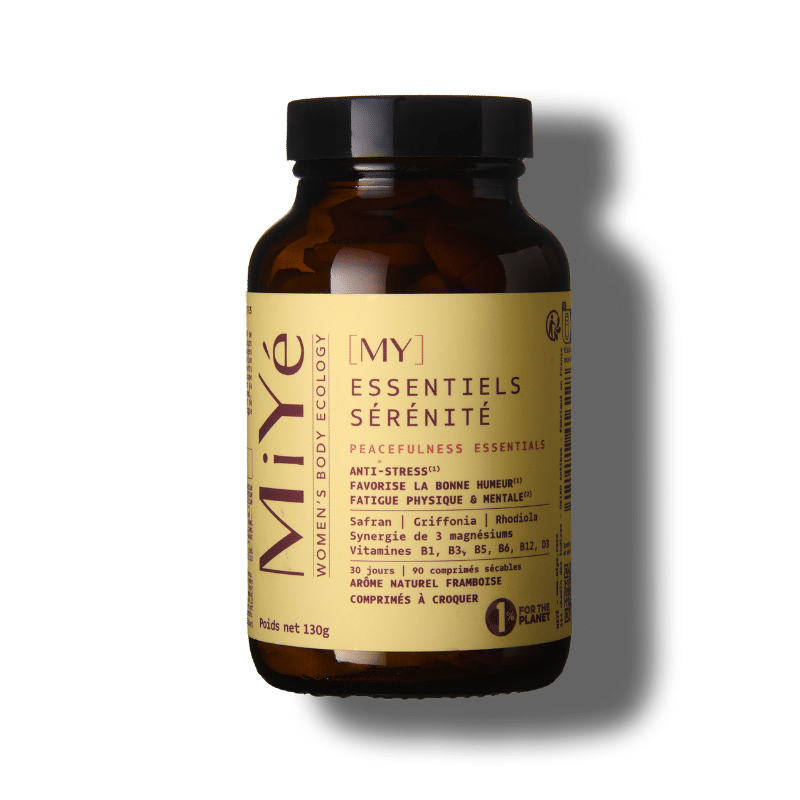
The priority is to learn to limit, control, and release stress: sports, regular breaks, breathing exercises, meditation, delegating, organizing, writing, spending time outdoors... Going out into daylight for at least 15/20 minutes (preferably in the morning or midday) also helps support vitamin D production. You can also use dietary supplements against cortisol or plants like ashwagandha, lemon balm, rhodiola, saffron, griffonia, and supplement with magnesium, notably via Serenity Essentials.
On your plate, focus on healthy fats (omega-3): fatty fish, prioritizing smaller ones (sardines, mackerel, anchovies...), chia seeds, rapeseed/flax/hemp oils... Add fruits and vegetables to every meal to pack in antioxidants. And reduce sweets, red meat, industrial dishes, and dairy products.
Stress management is a key factor for our health and proper hormonal balance. Its negative short- and long-term effects impact all our bodily functions. So, while we may not be able to avoid it in our modern lives, let's learn to keep it within acceptable limits and mitigate its consequences on our bodies!
RECOMMENDED PRODUCT
Serenity Essentials is specially formulated to support the body when dealing with chronic stress and excess cortisol, thanks to a synergistic blend of adaptogenic plants (saffron, griffonia, rhodiola), highly absorbable magnesium, and vitamins B & D.
Symptoms: Nervous fatigue and mental exhaustion, Irritability and mood swings, Physical tension linked to stress
When should you go see a doctor?
It is important to consult a doctor in order to quickly diagnose a possible Cushing's syndrome. General practitioners and endocrinologists are both capable of making a diagnosis and offering appropriate management.
FAQ
Is it serious to have a high cortisol level?
An occasionally high cortisol level is not serious: it is a normal response to stress.
However, when it remains high over the long term, it can have negative effects on health: weight gain, hormonal disorders, lower immunity, or an increased risk of cardiovascular diseases.
In rarer cases, a significant excess of cortisol can be linked to a disease such as Cushing's syndrome.
How to lower your cortisol?
To reduce cortisol, you need to address stress and lifestyle choices:
- improve sleep (7 to 9 hours per night)
- practice relaxation techniques (breathing exercises, meditation, yoga)
- adopt a balanced diet (less sugar, caffeine, alcohol)
- engage in moderate physical activity
These habits help naturally regulate cortisol production.
What are the symptoms of cortisol?
An excess of cortisol can cause: persistent fatigue, sleep disturbances, anxiety, irritability, difficulty concentrating, and weight gain (often in the abdominal area).
Cravings, decreased immunity, or mood changes may also be observed.
What makes cortisol go up?
The main cause is chronic stress (physical or emotional).
Other factors can also increase cortisol:
- lack of sleep
- excess caffeine or alcohol
- unbalanced diet
- athletic overtraining
These elements disrupt hormonal balance and keep the body in a state of alert.

![[MY] PACK ÉQUILIBRE](http://www.miye.care/cdn/shop/files/ack_equilibre.png?v=1755857561&width=1080)
Share:
What is the link between progesterone deficiency and hormonal imbalance ?
Tingling in the menopause
2 comments
Bonjour,
Merci pour votre commentaire !
Nous vous conseillons l’application “petit bambou”.
Merci
Merci pour le partage très instructif sur le cortisol et son lien avec le stress. Il est essentiel de comprendre l’impact de cette hormone sur notre santé hormonale globale.
Je suis particulièrement frappé par le fait que les glandes surrénales d’un homme sont 50% plus grandes que celles d’une femme. Cela souligne à quel point il est crucial de surveiller et de gérer notre niveau de stress, surtout pour les femmes qui jonglent avec de multiples responsabilités.
Vos conseils pour réduire le taux de cortisol, notamment l’importance de l’activité physique, de la méditation et de l’alimentation équilibrée, sont très pertinents. Avez-vous des recommandations spécifiques en matière de méditation ou d’exercices qui peuvent aider à maîtriser le niveau de cortisol ?
Encore merci pour ce partage éclairant !