






CALCIUM CITRATE
Calcium citrate is the most well-tolerated and flexible form of calcium for supplementation.

CALCIUM CITRATE
OPTIMIZED ABSORPTION | DIGESTIVE TOLERANCE | BONE HEALTH
Calcium citrate is one of the best-absorbed forms of calcium in supplementation and arguably the most versatile. Its particularity lies in its independence from gastric acidity: unlike calcium carbonate, it can be taken on an empty stomach or with a meal, with effective absorption regardless of gastric acid production.
This form of calcium – a salt resulting from the combination of calcium with citric acid – offers superior digestive tolerance, documented bioavailability, and versatility of use, making it a reference choice for perimenopausal women, people taking proton pump inhibitors (PPIs), or those with gastric sensitivity. Less concentrated in elemental calcium than carbonate, it compensates with significantly more efficient absorption.
What is calcium citrate? Definition and origin
Calcium citrate [Ca₃(C₆H₅O₇)₂] is an organic salt obtained by the reaction of calcium with citric acid, an acid naturally present in citrus fruits and produced by the body in the Krebs cycle (cellular energy production). It contains about 21% elemental calcium, compared to 40% for carbonate – meaning a larger dose of citrate is needed to provide the same amount of active calcium.
Its high solubility in an aqueous medium and its absorption independent of gastric pH are its two major advantages over other calcium salts. The citric acid it contains facilitates the formation of soluble complexes with calcium in the small intestine, allowing for effective absorption even in the absence of sufficient gastric hydrochloric acid.
In production, calcium citrate is primarily obtained by chemical synthesis or by fermentation of citric acid from carbohydrate sources (sugarcane, molasses). It is used both in food supplements and in the food industry as an acidity regulator and stabilizer.
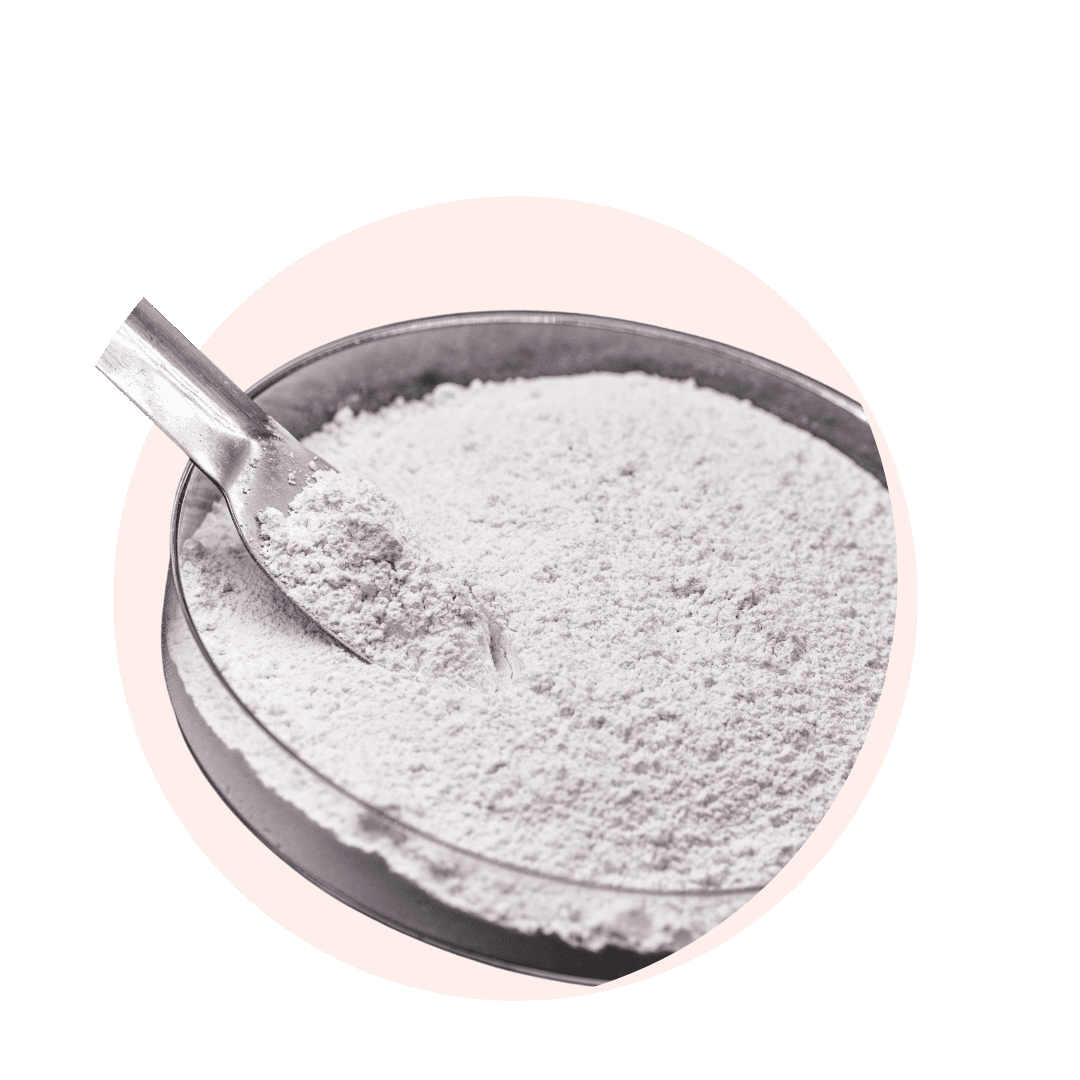
Its physical form is a fine white powder, practically odorless and with a slightly acidic taste, which lends itself to formulation in capsules, tablets, dissolvable powders, and sachets.
Citrate vs. carbonate: understanding the differences
- Calcium Citrate
- 21% elemental calcium
- Absorption independent of gastric pH
- Can be taken on an empty stomach or with a meal
- Excellent digestive tolerance
- Recommended for PPI users or those with low acidity
- Lower risk of constipation
- Generally bulkier formula
- Calcium Carbonate
- 40% elemental calcium
- Requires gastric acid for absorption
- Must be taken with a meal
- May cause bloating, constipation
- Less suitable for PPI users or those with reflux
- More concentrated form, smaller tablets
- Generally lower cost
In practice, calcium citrate is the preferred form whenever digestive tolerance, flexibility of intake, or a context of low gastric acidity is a concern – which represents a large proportion of perimenopausal women and beyond.
What are the benefits of calcium citrate?
Optimized absorption, independent of meals
Comparative studies have shown that calcium citrate has superior bioavailability to carbonate, especially on an empty stomach and in elderly individuals or those undergoing treatment that reduces gastric acidity. A meta-analysis by Sakhaee et al. (1999) confirmed significantly higher absorption for citrate compared to carbonate under these conditions.
This independence from gastric pH is particularly valuable for perimenopausal women: gastric acid production tends to decrease with age, which can compromise calcium carbonate absorption and make supplementation less effective.
Bone health and prevention of mineral density loss
Calcium citrate contributes to the maintenance of normal bones, a nutritional claim recognized by the EFSA, just like other forms of calcium. Its better absorption makes it a particularly relevant active ingredient in formulas focused on women's bone health, where the actual effectiveness of calcium intake is as important as the theoretical dose.
Combined with vitamin D3 (which optimizes intestinal absorption) and vitamin K2 MK-7 (which directs calcium to the bones and prevents arterial calcification), calcium citrate is part of the reference triad for comprehensive bone support, especially during perimenopause and postmenopause.
Superior digestive tolerance
One of the major obstacles to adherence in calcium supplementation is digestive discomfort – constipation, bloating, heaviness – frequently associated with calcium carbonate. Citrate, due to its organic chemical structure and high solubility, is significantly better tolerated. It does not require acid neutralization in the stomach, which limits the fermentation and gas phenomena often observed with carbonate.
Benefits for people taking PPIs or with low gastric acidity
Proton pump inhibitors (PPIs, prescribed for gastroesophageal reflux or ulcers) significantly reduce gastric acid production. This reduction compromises the absorption of calcium carbonate, which depends on this acidic environment. Calcium citrate, absorbed independently of pH, is the recommended form in this context – a common situation for women aged 45 and over.
Alkalizing effect and prevention of urinary stones
The citric acid contained in calcium citrate has an alkalizing effect on urine, increasing urinary pH and citrate concentration – a natural inhibitor of oxalate-calcium crystallization. Clinical studies have shown that calcium citrate, unlike carbonate, does not promote kidney stone formation and may even help reduce their risk in individuals predisposed to oxalate-calcium stones.
Female hormonal comfort
Like all forms of calcium, citrate helps reduce symptoms of premenstrual syndrome (PMS) – cramps, mood swings, water retention – as documented by several clinical studies. Its better tolerance promotes regular intake and therefore sustained effectiveness over time, a determining factor for the hormonal benefits of calcium.
Instructions for use of calcium citrate
Calcium citrate is used as an oral supplement, in the form of capsules, tablets, or powder. Some essential guidelines:
- Dose per intake:do not exceed 500 mg of elemental calcium per intake to maximize intestinal absorption. Divide doses throughout the day if the target is greater than 500 mg/day.
- Time of intake:citrate can be taken on an empty stomach or with a meal – this is one of its main advantages. Evening intake (dinner) is often recommended because bone remodeling is slightly more active at night.
- Recommended combinations:always combine with vitamin D3 (essential for intestinal calcium absorption) and vitamin K2 MK-7 (bone fixation and vascular protection). Magnesium usefully complements the formula.
- Total intake:take into account dietary intake. The goal is to reach the NRVs (1,000 mg/day for adults, 1,200 mg/day after 50) by combining diet and supplementation, without exceeding 2,000 mg/day total.
- Duration:calcium supplementation should be considered long-term, especially during perimenopause and postmenopause. Bone health is preserved over months and years, not weeks.
⚠️ Calcium citrate contains 21% elemental calcium. Check the elemental calcium dose indicated on the supplement label, not the total calcium citrate dose, to assess the actual intake.
Precautions for use of calcium citrate
Calcium citrate has an excellent tolerance profile. Some points of vigilance should still be considered:
- Excessive intake:like any form of calcium, a total excess (diet + supplementation) greater than 2,000-2,500 mg/day can lead to hypercalcemia. Respect the recommended doses.
- Drug interactions:calcium can reduce the absorption of certain medications – antibiotics (tetracyclines, fluoroquinolones), levothyroxine, bisphosphonates, iron. Space out doses by at least 2 hours.
- Kidney failure:any calcium supplementation must be medically supervised in cases of chronic kidney failure, due to the risks of phosphocalcium imbalance.
- Calcium stones:although citrate is less lithogenic than carbonate, individuals with a history of calcium kidney stones should consult a healthcare professional before supplementing.
⚠️ Pregnant and breastfeeding women have high calcium needs (1,000 mg/day). Calcium citrate supplementation is possible but should be discussed with a healthcare professional, especially in the presence of other prescribed supplements.
Frequently Asked Questions about Calcium Citrate
Why choose calcium citrate over carbonate?
Citrate is preferable if you are taking PPIs or antacids, if you have digestive sensitivity (bloating, constipation with carbonate), if you want to take your calcium on an empty stomach, or if you are perimenopausal – a period when gastric acidity tends to decrease and carbonate absorption may be less effective.
Is calcium citrate suitable for people with kidney stones?
Contrary to popular belief, dietary calcium and calcium citrate do not promote oxalate-calcium kidney stones. Citrate even increases urinary pH and urinary citrate concentration, naturally inhibiting crystallization. It may therefore be preferable to carbonate in people at risk of lithiasis – however, medical advice is still recommended.
Can calcium citrate be taken without vitamin D?
Technically yes, but that would be missing out on a fundamental synergy. Without vitamin D3, only 10 to 15% of ingested calcium is absorbed by the intestine. The combination of calcium citrate + vitamin D3 is the basic combination for truly effective calcium intake. Vitamin K2 MK-7 ideally complements this duo by ensuring bone fixation of calcium and protecting arterial walls.
Sources
Sakhaee K et al. "Meta-analysis of calcium bioavailability: a comparison of calcium citrate with calcium carbonate." American Journal of Therapeutics, 1999.
Straub DA. "Calcium supplementation in clinical practice: a review of forms, doses, and indications." Nutrition in Clinical Practice, 2007.
Odvina CV. "Comparative value of orange juice versus lemonade in reducing stone-forming risk." Clinical Journal of the American Society of Nephrology, 2006.
EFSA Panel on Dietetic Products. "Scientific Opinion on Dietary Reference Values for Calcium." EFSA Journal, 2015.
Bolland MJ et al. "Effect of calcium supplements on risk of myocardial infarction and cardiovascular events." BMJ, 2010.
Gröber U et al. "Vitamin K: An Old Vitamin in a New Perspective." Dermato-Endocrinology, 2014.