




WHEAT SEED EXTRACT RICH IN CERAMIDES
Ceramide-rich wheat seed extract is a scientifically documented beauty-from-within active ingredient.

WHEAT SEED EXTRACT RICH IN CERAMIDES
SKIN BARRIER ⎪ DEEP HYDRATION ⎪ HORMONAL DRYNESS
Ceramides are the structural lipids of the skin; they make up about 50% of the lipids in the stratum corneum and form the intercellular cement that maintains the impermeability of the skin barrier. Without them, the skin loses water, becomes fragile, and reactive. With age and hormonal fluctuations, their content in the epidermis naturally decreases; a reality that oral ceramides supplementation addresses from within.
Wheat seed extract rich in ceramides is today one of the best-documented plant-based sources for oral supplementation for the skin. Derived from wheat grain, naturally concentrated in glucosylceramides, it acts systemically to replenish the lipid reserves of the epidermis—a scientifically validated inner beauty approach, particularly relevant for women whose skin reacts to hormonal fluctuations.
What is wheat seed extract rich in ceramides? Definition and origin
Ceramides are sphingolipids—complex lipids consisting of a sphingoid base (sphingosine or phytosphingosine) linked by an amide bond to a fatty acid. They belong to the large family of skin barrier lipids, alongside free fatty acids and cholesterol, which together form the lipid lamellae of the stratum corneum.
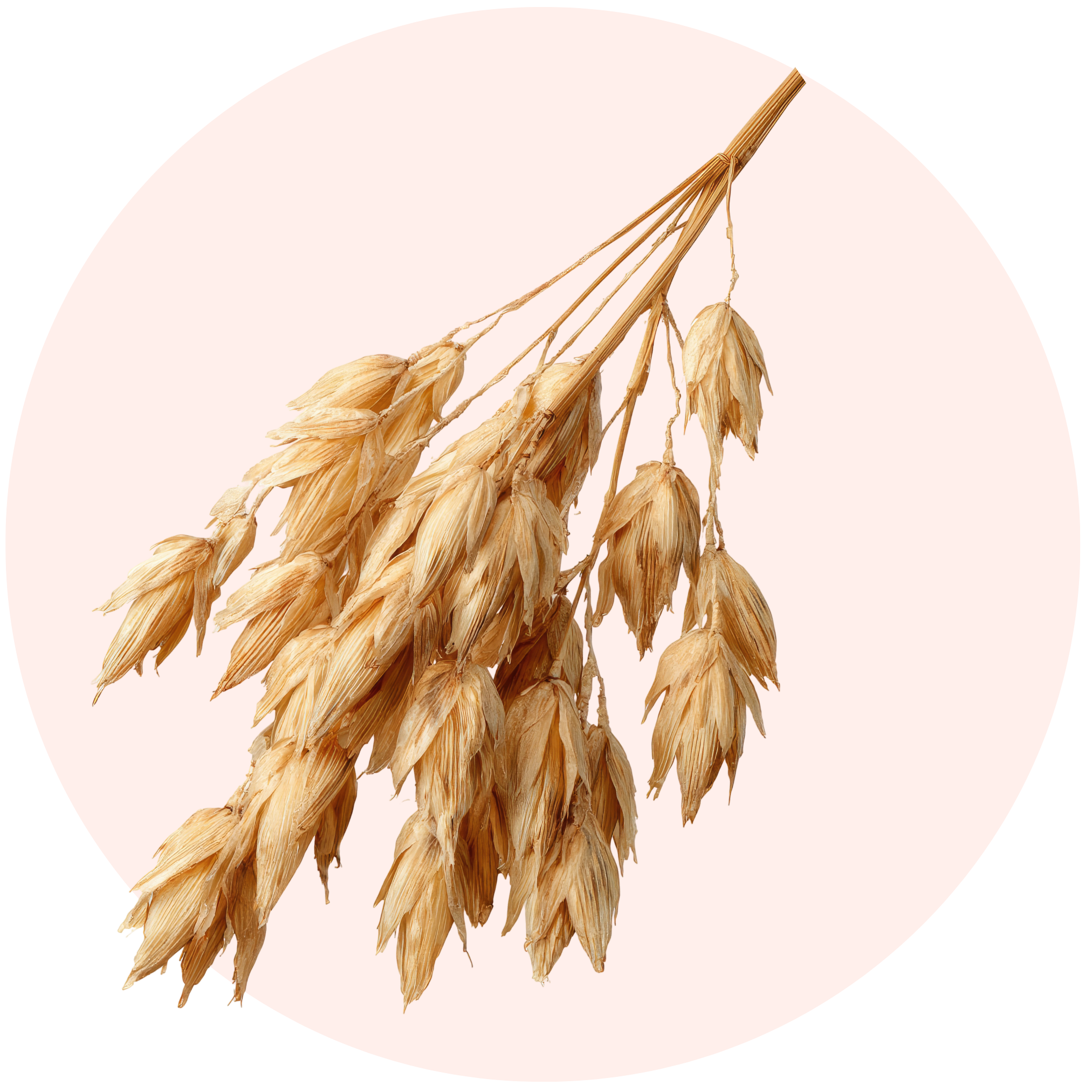
Wheat grain (Triticum aestivum) is naturally rich in glucosylceramides—the glycosylated form of ceramides, in which a glucose is linked to the sphingoid head. These plant-based glucosylceramides have a structure similar to human ceramides, which gives them significant biological activity orally. After ingestion, they are hydrolyzed in the intestine into active ceramides, absorbed, and redistributed to target tissues, including the skin.
Extraction is carried out from the germ or the hull of the wheat grain, the fractions most concentrated in polar lipids. Standardized extracts (such as Lipowheat®, a clinically studied reference) are titrated in active glucosylceramides to ensure a reproducible functional concentration.
Botanically, wheat is a cereal from the Poaceae family (grasses), cultivated worldwide. Its grain contains, in addition to starch and proteins, a minor but biologically active lipid fraction—of which glucosylceramides are the active ingredient of interest in dermocosmetics and supplementation.
Composition and active forms
Wheat seed extract rich in ceramides is mainly available in the following forms for supplementation:
- Standardized extract of glucosylceramides: Reference form, titrated to 0.1-0.3% active glucosylceramides. Basis of available clinical studies (e.g., Lipowheat®).
- Enriched wheat germ oil: Total lipid fraction of the germ, less concentrated in glucosylceramides but rich in vitamin E and unsaturated fatty acids—antioxidant and barrier synergy.
- Polar lipid complex: Fraction of polar lipids (glucosylceramides + phospholipids) for enhanced action on the skin barrier and intercellular hydration.
- Liposomal formula: Encapsulation of plant ceramides in liposomes for protection against digestive degradation and optimized absorption.
The concentration of active glucosylceramides is the determining quality criterion. Clinically studied doses vary from 30 mg to 350 mg of standardized extract per day, depending on the titration rate. It is essential to refer to the dose of active glucosylceramides (generally expressed in mg) rather than the crude dose of extract.
What are the benefits of wheat seed extract rich in ceramides?
Reconstruction of the skin barrier
Ceramides make up about 50% of the lipids in the stratum corneum. Their accelerated decrease due to aging, hormonal fluctuations, and environmental aggressions alters the impermeability of the epidermal barrier, leading to transepidermal water loss (TEWL), dry skin, and reactive hypersensitivity. Oral supplementation with wheat glucosylceramides helps restore this lipid capital from within, by supporting the endogenous synthesis of epidermal ceramides.
Deep hydration and reduction of dryness
A randomized, double-blind clinical study (Guillou et al., 2011) involving women with dry skin demonstrated that daily supplementation with wheat extract rich in glucosylceramides (350 mg/day for 3 months) significantly improved skin hydration, reduced roughness, and decreased TEWL compared to placebo. These results position this active ingredient as a systemic moisturizer, acting in complementarity with topical care.
Specific interest in the female hormonal context
The decrease in estrogen during perimenopause and menopause directly reduces the synthesis of skin ceramides and the expression of genes involved in epidermal cohesion. The skin becomes drier, thinner, less elastic—a development often experienced as a loss of comfort and confidence. Wheat seed extract rich in ceramides provides a coherent physiological response, supporting from within the lipid reconstruction that topical care alone cannot fully compensate for.
Improvement of skin elasticity and suppleness
By restoring the integrity of the lipid barrier, oral ceramides help improve skin suppleness and elasticity. Some studies suggest an improvement in skin roughness and a reduction in feelings of tightness after 4 to 8 weeks of regular supplementation.
Reduction of skin reactivity
An intact skin barrier is the first line of defense against irritants, allergens, and microorganisms. By strengthening this barrier from within, plant ceramides help reduce skin reactivity, redness, and feelings of discomfort—particularly for sensitive skin or skin prone to eczema.
Instructions for use
For oral supplementation
Clinically studied doses vary depending on the extract concentration:
- Standardized extract (Lipowheat® type): 30 to 100 mg/day of extract titrated to 0.1-0.3% glucosylceramides
- Less concentrated extract: up to 350 mg/day depending on the formula
- Can be taken with a lipid-containing meal to promote sphingolipid absorption
- Consistency is key: effects on the skin barrier build up over 4 to 12 weeks of continuous intake
The most coherent synergistic combinations are: L-ascorbic acid (cofactor of collagen synthesis and skin antioxidant), omega-3 fatty acids (support for membrane fluidity), vitamin E (antioxidant protection of membrane lipids), and hyaluronan (complementary extracellular hydration).
For topical use
Wheat seed extract can also be integrated into topical formulas—barrier creams, restructuring serums, body care. Topically, ceramides act directly on the stratum corneum:
- Usual concentrations in cosmetics: 0.5 to 3% active ceramides in the final formula
- Recommended combination: ceramides + fatty acids + cholesterol to reconstitute the natural lipid complex in its physiological proportions
- Texture: rich creams or balms for very dry skin; light emulsions for daily face maintenance
- Application: morning and evening on clean skin, before or after moisturizing care depending on texture
⚠️ Wheat seed extract contains gluten. People with celiac disease or wheat allergy should avoid this source of ceramides and opt for gluten-free alternatives (rice, corn, or konjac ceramides). Always check the label and traceability of the extract.
Precautions for use
- Wheat allergy and celiac disease:Absolute contraindication for people allergic to wheat or suffering from celiac disease, due to the presence of residual gluten proteins in unpurified extracts. Some certified gluten-free extracts exist—check certification.
- Digestive tolerance:Wheat ceramides are generally very well tolerated at usual doses. Temporary digestive discomfort may occur at the beginning of the treatment, spontaneously subsiding.
- Pregnancy and breastfeeding:In the absence of sufficient data on this population, medical consultation is recommended before supplementation during pregnancy or breastfeeding.
- Quality and standardization:The effectiveness of the extract directly depends on its content of active glucosylceramides. Prioritize certified, standardized extracts from traceable raw materials.
Frequently asked questions
Why take ceramides orally rather than just in cream?
Topical ceramides act on the surface of the stratum corneum, where they are applied. Oral ceramides, on the other hand, are absorbed by the intestine, enter the systemic circulation, and reach the deep layers of the epidermis—where ceramide synthesis occurs. Both approaches are complementary: the oral route rebuilds lipid capital from within, the topical route strengthens and protects the surface. For very dry or reactive skin, combining both routes is often the most effective.
Is wheat extract suitable for people with gluten intolerance?
People with celiac disease or confirmed wheat allergy should be cautious. Some extracts are purified and certified gluten-free—in this case, the protein fraction (responsible for the immune reaction) has been removed, leaving only the active lipid fraction. It is essential to check the gluten-free certification of the specific extract used. If in doubt, plant-based alternatives exist: rice, corn, or konjac ceramides.
Why is this active ingredient particularly relevant during perimenopause?
The drop in estrogen during perimenopause directly reduces the expression of genes encoding the enzymes for skin ceramide synthesis. The skin becomes drier, thinner, feelings of tightness intensify, and reactivity increases. These changes are not just cosmetic—they reflect a deep biological reality. Wheat seed extract rich in ceramides provides a coherent response to support from within what estrogen no longer does as well.
How long does it take to see effects?
The first improvements in skin hydration and comfort are generally noticeable after 4 to 6 weeks of regular supplementation. Benefits for elasticity, suppleness, and reduction of TEWL are consolidated over 8 to 12 weeks of continuous intake, according to available clinical data. Daily regularity is the most determining factor.
Sources
Guillou S et al. "The moisturizing effect of a wheat extract food supplement on women's skin."International Journal of Cosmetic Science, 2011.
Elias PM. "Skin barrier function."Current Allergy and Asthma Reports, 2008.
Coderch L et al. "Ceramides and skin function."American Journal of Clinical Dermatology, 2003.
Asai S et al. "Dietary glucosylceramide from wheat can improve intestinal barrier function."Journal of Agricultural and Food Chemistry, 2012.
Uchiyama T et al. "Oral intake of glucosylceramide improves the skin barrier function."Journal of Health Science, 2008.
Verdier-Sévrain S, Bonté F. "Skin hydration: a review on its molecular mechanisms."Journal of Cosmetic Dermatology, 2007.