





SUMMARY

Summary:
Persistent fatigue in women is often linked to hormonal variations, prolonged stress or insufficient intake of certain essential nutrients
Magnesium, B-group vitamins, iron and certain plants such as ashwagandha are among the best-documented actives for naturally supporting energy levels
Choosing a supplement tailored to your fatigue profile is far more effective than a generic formula
Effects are generally felt after 3 to 4 weeks of regular use
A medical check-up remains recommended before any supplementation, particularly to assess your iron and vitamin D reserves
Why are women particularly affected by chronic fatigue?
The underestimated role of hormones in your daily energy levels
Hormones do not only regulate your cycle or your mood: they directly influence energy production at the cellular level. Oestrogens in particular contribute to the proper functioning of mitochondria — the energy powerhouses present in every cell. When their levels fluctuate (luteal phase, postpartum, perimenopause), overall vitality can be affected.
Cortisol, the stress-response hormone, also plays an ambiguous role: in the right quantity, it mobilises the body's resources. In chronic excess, it depletes them. A hormonal imbalance is not always visible in a standard blood test, but it is clearly felt in daily life.
Fragmented sleep and waking too early: the cortisol signal that often goes unnoticed
You fall asleep without difficulty, then open your eyes at 3 or 4 in the morning, your mind already racing. And when you wake up, the tiredness is still there.
Cortisol follows a circadian rhythm: at its lowest in the early part of the night, it rises again in the second half of the night to prepare for waking (Inserm). When the body has been under strain for a long time, this rhythm can lose its balance and trigger an early awakening.
Night after night, a sleep debt builds up. And it is often this debt, more than any single missing nutrient, that keeps the next day's fatigue going.
No supplement can make up for sleep that stays fragmented over time. The fundamentals therefore come first: natural light in the morning, a lighter dinner, eaten earlier, consistent bedtimes, evenings without alcohol or screens.
Once those foundations are in place, micronutrition makes full sense. Magnesium contributes to the normal functioning of the nervous system and to normal psychological function (health claims authorised by EFSA).
If these early awakenings have been going on for several weeks, speak to your doctor.
The 5 most common causes of fatigue in women aged 30 to 45
Female fatigue takes many forms. Here are the most well-documented origins:
- Iron deficiency: menstrual losses regularly expose women of reproductive age to an iron shortfall — often silent but with a very significant impact on energy and concentration.
- Persistently elevated cortisol: professional stress, mental load, emotional overinvestment... a nervous system under constant tension consumes considerable energy resources.
- Deficiencies in key micronutrients: magnesium, vitamins B6 and B12, and vitamin D are often below recommended intake levels, particularly with a depleted modern diet.
- Cyclical hormonal fluctuations: the drop in progesterone and oestrogen during the premenstrual phase or during menstruation generates a very real fatigue that is still too often dismissed.
- A progressively slowing metabolism: after the age of 35–40, the thyroid, the stress-related hormonal system and the production of energy coenzymes can progressively weaken — without pathological thresholds being reached.
How do you know if your fatigue is hormonal in origin?
A few signals are telling:
- Fatigue that follows the rhythm of your cycle,
- A marked energy dip in the second half of the cycle,
- Persistent morning brain fog,
- Or vitality that has gradually changed after the age of 40.
These signs are worth discussing with your doctor, who can guide appropriate biological investigations. Food supplements do not replace a medical check-up, but they can effectively support the body once the underlying causes have been identified.
The best natural actives in an energy food supplement for women
Magnesium: the essential cornerstone of female energy
Magnesium is involved in more than 300 enzymatic reactions, including the synthesis of ATP — the "energy currency" of your cells. According to dietary consumption data, approximately 70 to 75% of French women do not reach the recommended daily intake. The European Food Safety Authority (EFSA) recognises that magnesium "contributes to the reduction of tiredness and fatigue" and "contributes to normal energy-yielding metabolism". A deficiency often manifests as persistent fatigue, cramps, irritability and sleep disturbances. Favour highly bioavailable forms: magnesium bisglycinate or glycerophosphate.
To make a better-informed choice about your magnesium, you can consult this article: Which magnesium is most effective?
B-group vitamins: the true engines of your energy metabolism
Vitamins B1, B2, B3, B5, B6, B9 and B12 are all involved in normal energy metabolism, according to claims validated by EFSA. They participate in the conversion of carbohydrates, fats and proteins into energy that your cells can use. B6 and B9 additionally play a role in hormonal regulation, while B12 — often deficient in women following a vegetarian diet — is indispensable for the production of red blood cells and for combating fatigue.
Iron: the forgotten anti-fatigue ally for women of reproductive age
Iron participates in the transport of oxygen in the blood via haemoglobin. When it is insufficient, cells are less well oxygenated: fatigue sets in and cognitive performance declines. EFSA confirms that iron "contributes to the reduction of tiredness and fatigue". Before supplementing, a check-up including measurement of your iron reserves (ferritin) is recommended: excess iron is just as harmful as a deficiency. If a deficiency is identified, opt for forms that are well tolerated digestively (iron bisglycinate, for example).
Adaptogenic plants: the secret to lasting energy without an artificial boost
Unlike caffeine, adaptogenic plants support the body's natural capacity to cope with stress and maintain inner balance. Ashwagandha (Withania somnifera) is the best-documented: several clinical studies suggest a positive effect on the perception of fatigue and resilience in the face of stress. Rhodiola rosea is traditionally used to support mental and physical performance in situations of exhaustion. These plants act gently, without creating dependency or causing a rebound effect.
Note: in France, claims about plants do not fall under Regulation EC 1924/2006; the benefits referred to are based on recognised traditional uses and the available clinical data.
Vitamin C, Coenzyme Q10 and spirulina: complementary boosters not to be overlooked
Vitamin C "contributes to the reduction of tiredness and fatigue" (EFSA) and improves the absorption of iron from plant sources, making it a valuable ally for women with deficiencies. Coenzyme Q10 (CoQ10) plays a direct role in mitochondrial energy production and tends to decline with age, particularly after 40. Spirulina — a microalgae rich in iron, proteins and B vitamins — is a concentrated source of energising nutrients, provided you choose a certified spirulina that has been tested for the absence of contaminants.
How to choose your energy food supplement according to your profile
You are permanently tired and stressed: focus on cortisol
If your fatigue is accompanied by constant tension, mental overactivity in the evening, difficulty falling asleep or night-time waking, this is often the signal of a stress-cortisol axis that is being overworked. The priority approach combines highly absorbable magnesium, B vitamins and adaptogenic plants to support the nervous system and help the body better modulate its stress response.
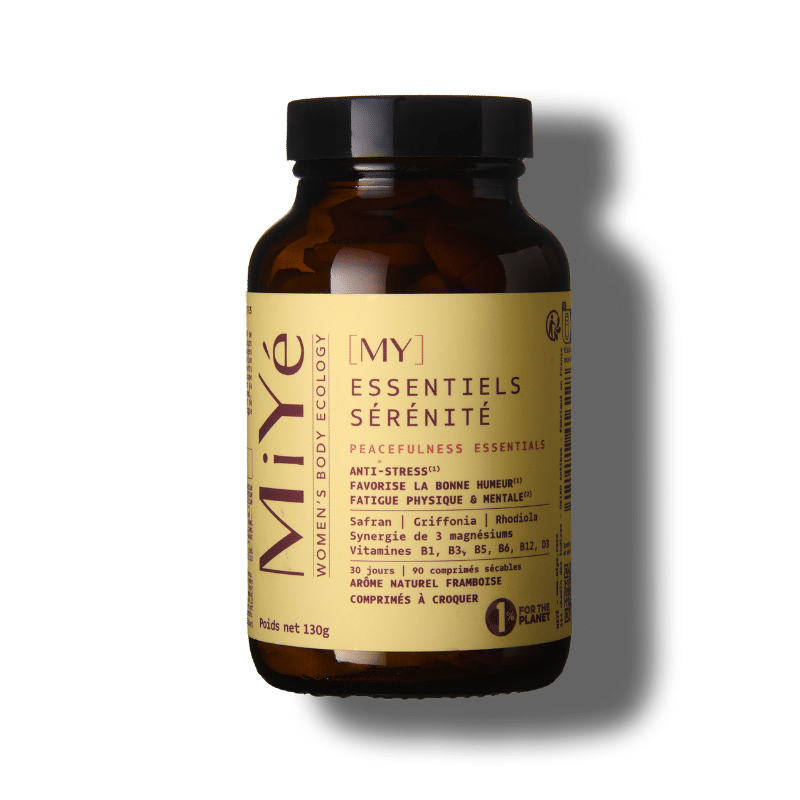
[MY] SERENITY ESSENTIALS has been formulated to support precisely this profile: daily support for the nervous system with actives selected for their efficacy and tolerability.
Your energy varies according to the phases of your cycle: think hormonal
Have you noticed that your vitality follows the rhythm of your cycle? Marked fatigue in the second half of the cycle, exhausting days after your period, cyclical irritability? These fluctuations are real, and they are not a sign of weakness: your body goes through hormonal variations that directly influence your energy. The idea is to adapt your nutritional support to these phases, rather than adopting a uniform supplementation throughout the month.
[MY] DUO FEEL GOOD has been designed for women whose energy follows the fluctuations of the cycle, with an approach conceived to support each phase.
You lack energy from the morning and struggle to get going: think metabolism

If you wake up tired despite a full night's sleep, your energy stays at its lowest in the morning and only really picks up in the late afternoon, this is often the sign of a metabolism running in slow mode. B vitamins, iodine, chromium and certain enzymatic cofactors play a central role here.
You are over 40 and your energy has changed: the perimenopause track
After the age of 40, oestrogen production begins to fluctuate in a less predictable way. These variations can affect sleep quality, recovery and energy more markedly than in previous decades. Perimenopausal fatigue is often multifactorial: less restorative nights, greater effort needed to maintain the same performance, vitality that gradually diminishes.
In this context, a medical check-up is particularly useful for ruling out other causes (thyroid, vitamin D deficiency, anaemia). Micronutrition can then provide targeted support. Don't hesitate to speak to your doctor : persistent or long-lasting fatigue is rarely without cause and may point to other underlying conditions.

Mistakes to avoid with energy food supplements
- Choosing a generic product without targeting your real cause: a "multi-energy" formula may provide nutrients you do not need, at the expense of those you are genuinely lacking.
- Stopping too early: micronutrition takes time. Most actives require 4 to 8 weeks of regular use before a perceptible effect becomes established.
- Accumulating supplements without coherence: some nutrients compete with each other (iron and calcium, for example), while others enhance one another. A targeted approach is always preferable to unsupervised accumulation.
- Neglecting the fundamentals: no food supplement replaces sufficient sleep, a varied diet and regular physical activity. It provides support — not a substitute.
- Ignoring possible drug interactions: if you are following a treatment, always seek the advice of your doctor or pharmacist before starting a supplementation.
- Relying solely on price: the quality of a supplement depends on the form of the actives, their bioavailability, the absence of unnecessary additives and the quality controls carried out — not on its price positioning.
Your questions about energy food supplements
What is the best food supplement for regaining energy?
There is no universal formula. The most effective supplement is the one that matches your cause of fatigue. For a woman with an iron deficiency, a well-tolerated iron supplementation will be the priority. For someone experiencing chronic stress, the combination of magnesium and B vitamins will be more relevant. Identifying your profile is the first step towards genuinely useful supplementation.
How long does it take to feel the effects of an energy food supplement?
The first perceptible effects generally appear after 3 to 4 weeks of regular use. A programme of 2 to 3 months is recommended to consolidate the benefits over time. Some actives such as magnesium can bring quicker comfort on associated symptoms (muscle tension, irritability). Effects on deep fatigue require greater regularity and consistency.
Can you take several energy food supplements at the same time?
Yes, under certain conditions. You need to ensure there are no overlaps between formulas (excessive intake of vitamin B6 or D, for example) and that the actives are compatible. If you are pregnant, breastfeeding or under medical treatment, consult your doctor or pharmacist before any combination.
Are energy food supplements effective for women in perimenopause?
Yes, provided you choose actives suited to this specific period. Perimenopause is often accompanied by sleep disturbances, significant hormonal variations and poorer overall recovery. Actives such as magnesium, B vitamins, vitamin D or ashwagandha can contribute to supporting energy and wellbeing at this stage. Medical monitoring remains recommended for a comprehensive approach.
Are there side effects with natural energy food supplements?
Well-formulated supplements at appropriate dosages are generally well tolerated. A few precautions are nonetheless required: iron can cause digestive discomfort (preferably take in bisglycinate form, possibly away from meals), certain adaptogenic plants are not recommended during pregnancy or breastfeeding, and high doses of fat-soluble vitamins (A, D, E, K) can accumulate in the body. Always respect the recommended doses and consult a professional if in doubt.
How do I know if my fatigue requires a medical consultation rather than a supplement?
Certain signals should prompt you to seek advice without delay: sudden-onset fatigue, unexplained weight loss, palpitations, unusual breathlessness, persistent deep sadness, or fatigue that does not ease despite rest. In these situations, a medical check-up is indispensable. Food supplements are supports for daily wellbeing: they do not replace appropriate medical care.
Our products do not constitute medical treatment. Consult your doctor if in doubt.
Sources:
- PubMed - Effects of extract of ashwagandha root in reducing stress and anxiety in adults: https://pubmed.ncbi.nlm.nih.gov/23439798/
- EFSA - Series of scientific opinions on generic functional health claims:
https://www.efsa.europa.eu/fr/press/news/nda100225 - ANSES - Third Individual and National Food Consumption Study:
https://www.anses.fr/system/files/ANSES-Ft-INCA32014.pdf



Share:
How to Stop Taking the Pill? The Complete Guide to a Smooth Hormonal Transition
MyCelsius x MiYé: a complementary approach to living better with hot flushes