




SUMMARY
- Can You Stop Taking the Pill Whenever You Want? What Medicine Really Says
- What Are the Risks Associated with the Pill?
- What Are the Different Types of Contraceptive Pills?
- The 3 Methods to Stop the Pill: How to Choose Based on Your Profile?
- What Side Effects Can You Expect After Stopping the Pill?
- How to Prepare Your Body for Stopping the Pill: The MiYé Natural Approach



Key Takeaways
You can stop taking the pill at any time, but finishing your current pack is generally recommended to limit unexpected bleeding and better predict the return of your period. Fertility can return very quickly, sometimes as early as the first cycle.
Three options exist: finishing the pack, a guided transition, or immediate cessation. Finishing the current pack remains the simplest and most commonly advised method, while a guided transition may be considered for women prone to migraines or pronounced hormonal side effects.
Temporary side effects are common after stopping: irregular cycles, menstrual pain, acne, fatigue, migraines, mood swings, temporary hair loss, or digestive issues may appear during the first few months.
Preparing your body before stopping can ease the hormonal transition. Magnesium, zinc, omega-3, vitamin B6, a nutrient-rich diet, quality sleep, and stress management are great ways to support yourself during this period.
Medical follow-up is still recommended, especially if the pill was prescribed for a hormonal condition (PCOS, acne, painful periods) or if symptoms persist for several months after stopping.
Can You Stop Taking the Pill Whenever You Want? What Medicine Really Says
From a strictly medical standpoint, there is no direct danger in stopping a combined oral contraceptive pill at any time, including in the middle of a pack. This choice is entirely up to your personal decision.
However, certain situations require prior medical advice:
- Smoking after the age of 35;
- Migraine with aura;
- Uncontrolled high blood pressure;
- History of venous thrombosis or pulmonary embolism;
- Recent history of cardiovascular disease or hormone-dependent cancers.
Many practitioners advise finishing the current pack when the cessation is not motivated by a serious adverse effect, in order to reduce the risk of premature withdrawal bleeding and to better anticipate the return of periods.
If you stop in the middle of a pack, bleeding may occur within 24 to 48 hours, mimicking a period without indicating a permanent hormonal imbalance. Remember that fertility returns quickly: after oral contraception, a return to normal fertility is observed on average within about three cycles, and ovulation can resume in the very first weeks. Without a backup method of contraception, pregnancy is therefore possible very quickly.
If, after stopping, you notice prolonged amenorrhea (> 3 months), highly irregular, painful, or heavy periods, or any unusual symptoms (intense fatigue, breast pain, signs of pregnancy), consult a healthcare professional without delay. They will be able to rule out pregnancy, evaluate your hormonal balance, and adjust your follow-up.
What Are the Risks Associated with the Pill?
Like any medication, the pill carries risks that are evaluated and monitored by health authorities. The most documented is venous thrombosis: according to the ANSM, it affects about 2 out of 10,000 women per year taking a 2nd-generation combined pill, and 3 to 4 out of 10,000 taking a 3rd- or 4th-generation pill, which is why the 2nd generation is recommended as a first-line option. For comparison, this risk is 0.5 to 1 out of 10,000 without any pill, and 6 out of 10,000 during pregnancy. Combined pills also slightly increase the risk of arterial thrombosis (stroke, heart attack), especially in cases of smoking, high blood pressure, or migraine with aura. Finally, long-term studies show a slight increase in breast cancer risk during use, which fades within ten years of stopping, while the risk of ovarian and endometrial cancer decreases with the duration of use. It is important to have a regular re-evaluation with your doctor or midwife, based on your age, lifestyle, and medical history.
What Are the Different Types of Contraceptive Pills?
Two main families:
1. Combined pills (estrogen-progestin): they combine an estrogen + a progestin. These are the most prescribed pills. They block ovulation and provide regular cycles. They are classified by generation based on the progestin used:
- 1st and 2nd generation (levonorgestrel): the oldest, recommended as first-line by the ANSM because they carry the lowest venous risk among combined pills
- 3rd generation (desogestrel, gestodene): sometimes better tolerated (skin, breasts), but carry a higher venous risk
- 4th generation (drospirenone): same risk profile as the 3rd
Note: the more recent the generation, the higher the risk of venous thrombosis, without any additional contraceptive benefit. This is the paradox of the numbering system.
2. Progestin-only pills (minipills): contain a single progestin, no estrogen. Taken continuously, without a break. No demonstrated increased venous risk, compatible with breastfeeding and contraindications to estrogen, but can lead to unpredictable cycles and irregular bleeding.
The 3 Methods to Stop the Pill: How to Choose Based on Your Profile?
Method 1 - Stopping Clean at the End of a Pack: The Most Common and Simplest Way
This is the simplest method and the one most often recommended during consultations. You simply do not start the next pack on the usual date. This helps you avoid unexpected bleeding mid-pack and makes it easier to anticipate the return of your period.
Method 2 - Guided Transition: Speaking with a Healthcare Professional
Some women dread a sudden hormonal shift, particularly if they are sensitive to migraines or experience pronounced hormonal effects. There is no validated protocol for gradually tapering off the pill: spacing out doses on your own initiative is not recommended, as it reduces contraceptive effectiveness without any demonstrated benefit for the transition.
However, a doctor or midwife can help you design a strategy tailored to your profile, such as temporarily switching to a lower-dose formula or a non-oral method before stopping completely. In any case, a non-hormonal backup contraception (condom, copper IUD) must be planned as soon as pill-taking becomes irregular.
Method 3 - Stopping Mid-Pack: Possible, but Requires Careful Planning
When tolerance is poor (intense nausea, altered mood, thrombotic risk) or for medical reasons, the pill can be discontinued immediately. Expect bleeding within 48 hours and an immediate loss of protection against pregnancy: arrange for a backup method of contraception and inform your practitioner. They may suggest an alternative hormonal solution (low-dose or non-oral) for a more gradual adjustment.
What Side Effects Can You Expect After Stopping the Pill?
- Absence of periods (amenorrhea) or irregular cycles (up to 3 cycles of adaptation);
- Increased menstrual pain and heavier flow;
- Return of acne or oily skin, if the pill was masking these symptoms;
- Fatigue, sleep disturbances, headaches, or migraines linked to hormonal fluctuations;
- Changes in weight and water retention;
- Mood swings, anxiety, lower libido;
- Temporary hair loss (telogen effluvium);
- Bloating and digestive discomfort.
These symptoms are generally temporary (2 to 3 months). If they persist in intensity, consult a professional.
How to Prepare Your Body for Stopping the Pill: The MiYé Natural Approach
4 to 6 Weeks Before Stopping: Essential Active Ingredients
- Magnesium (preferably bisglycinate, 300 mg/day): helps reduce fatigue and supports normal psychological function, which is useful during a transition period;
- Zinc (bisglycinate, 10 to 15 mg/day): contributes to the maintenance of normal skin, providing valuable support as the skin readjusts after stopping;
- Omega-3 (1 g of EPA/DHA per day): DHA contributes to normal brain function;
- Vitamin B6 (1.4 mg/day): contributes to the regulation of hormonal activity and normal psychological function;
- Probiotics (10⁹ CFU/day): to support the balance of the gut flora.
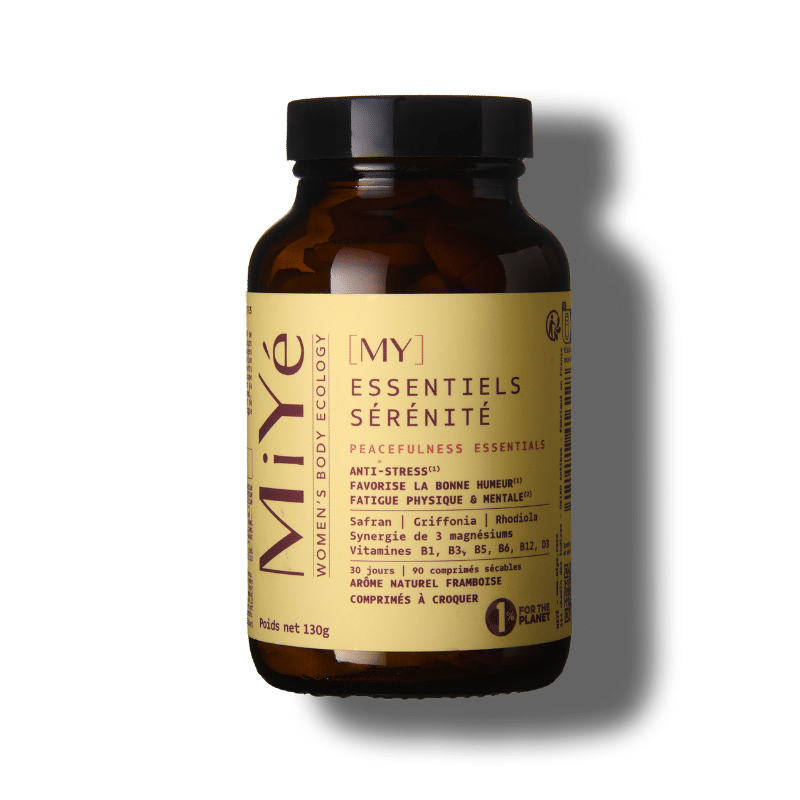
To make your transition easier: To help your body rebalance during this phase, you can discover MiYe Serenity Essentials, made with magnesium, and MiYe Intimate Flore Probiotics. Specially designed to support women experiencing hormonal fluctuations, it combines key vitamins and minerals to target cycles and mood from the inside out.
Supportive Diet
- Cruciferous and green vegetables, rich in fiber and micronutrients;
- Unsweetened herbal teas and infusions to support proper hydration: 2 to 3 cups/day;
- Lean proteins (fish, poultry, legumes) with every meal;
- Essential fatty acids (fatty fish, walnuts, rapeseed oil, avocado);
- Antioxidant-rich foods (berries, turmeric, green tea);
- Fermented foods or probiotics for gut health;
- Limiting refined sugars, ultra-processed products, and excess alcohol;
- Cleansing herbal teas (dandelion, milk thistle): 2 to 3 cups/day;
- A tailored diet helps regulate cycles after a hormonal shift.
Lifestyle and Stress Management
Ensure you get 7–8 hours of regular sleep, incorporate gentle daily activity (walking, yoga), and practice relaxation techniques (deep breathing, meditation) to reduce cortisol. Minimize your exposure to endocrine disruptors (plastics, conventional cosmetics) to avoid overloading a hormonal system that is rebalancing itself.
Stopping the pill is, above all, a personal decision backed by reassuring scientific data: long-term fertility is not affected, and the vast majority of women return to regular cycles within a few months. Whether it is stopping at the end of a pack, mid-pack, or through a guided transition, consulting a healthcare professional and implementing a backup contraception method remain essential to navigating this step smoothly. Finally, a dietary supplement dedicated to female balance can help manage certain discomforts related to hormonal fluctuations during this phase.
Dietary supplements are not a substitute for a varied and balanced diet or a healthy lifestyle. This article is intended for informational purposes and does not replace medical advice: for any questions regarding your health or contraception, please consult your doctor, gynecologist, or midwife.
Sources
- Contraceptive use and fecundability: prospective cohort study, BMJ, 2020
- Return of fertility after discontinuation of contraception: a systematic review and meta-analysis, Contraception and Reproductive Medicine, 2018
- Contraception: prescriptions and advice for women, Haute Autorité de Santé (French National Authority for Health)
- Contraception, Ameli.fr portal, Assurance Maladie (French National Health Insurance)
- Estrogen-progestin pills and thrombotic risk, ANSM (French National Agency for Medicines and Health Products Safety)
When do periods return after stopping?
Generally within 4 to 8 weeks after stopping, but it can take up to 3 cycles for a full regulation. Beyond 3 months without a period, consult a healthcare professional.
How long do side effects last?
Symptoms (acne, pain, mood, irregularities) can persist from a few weeks to several months. If the discomfort becomes too significant, consult a professional.
Should I consult a professional before stopping?
Although you can decide on your own, medical advice is recommended if the pill was prescribed for a specific condition (severe acne, PCOS, dysmenorrhea). A practitioner will adjust your follow-up and offer contraceptive alternatives or help with a pregnancy project.
Can I get pregnant immediately after stopping?
Yes: fertility often returns very quickly, sometimes as early as the first natural cycle. If you do not wish to become pregnant, adopt a backup method without delay or practice abstinence.
Which contraception should I choose after stopping?
The choice depends on your age, health, pregnancy plans, and hormonal tolerance. Options include:
- Non-oral hormonal methods (patch, ring, implant, hormonal IUD);
- Non-hormonal methods (copper IUD, condom, sterilization);
- Natural methods (fertility awareness methods, withdrawal).
A consultation with a professional will help you compare each solution and choose the one that suits you best.


![Pilulier [MY] Essentiels équilibre féminin sur fond transparent](http://www.miye.care/cdn/shop/files/Visuels-shop-25.png?v=1747987949&width=800)
Share:
Menstrual migraine: understanding and relieving headaches related to menstruation
Energy supplements: the guide to choosing according to your hormonal profile