



SUMMARY



For a long time, cosmetics focused on visibly correcting skin concerns: exfoliating more, speeding up cell renewal, intensely stimulating certain biological mechanisms. While these approaches delivered fast results, they also revealed their limits: a weakened skin barrier, discomfort, sensitisation or microbiome imbalances in some skin types.
Today, advances in skin biology invite us to change our perspective. What if the most effective skincare wasn't the kind that pushes the skin to react harder, but the kind that helps it work according to its own natural mechanisms? Cosmetic biomimicry, from the Greek bios (life) and mimesis (to imitate), does not seek to force the skin. It seeks to speak its own language: to provide what it recognises, what it naturally produces, what it needs to function at its best.
This approach is particularly relevant when it comes to preserving the skin barrier. Often pushed into the background behind concerns about radiance, firmness or wrinkles, it is nevertheless one of the pillars of skin health. A weakened barrier encourages dehydration, sensitivity and microbiome imbalances. Among the most interesting biomimetic actives to support it, postbiotics now hold a central place.
Key takeaways:
-
Postbiotics help preserve the skin barrier, the most overlooked part of the skin.
-
What biomimicry actually is: an approach inspired by what the skin naturally produces, to support it from within, without attacking or forcing it.
-
The key biomimetic actives and their precise roles: postbiotics, squalene, ceramides, standardised oat extract, plant-based pro-collagen, pro-retinol, peptides, each speaking a language the skin recognises.
-
Synergy makes all the difference: it is not a single active that transforms the skin, but the coherent interaction between them, layer by layer, from the dermis to the surface.
-
The results are subtle but lasting: no spectacular overnight effect, but renewed comfort, a more even complexion, skin that 'holds up' better, because we have worked with it, not against it.
Understanding the layers of the skin
To understand the value of biomimetic actives, we first need to recall how the skin is organised.
The epidermis is the outermost layer. A true protective barrier, it limits water loss, protects against external aggressions and hosts the skin microbiome.
Beneath the epidermis lies the dermis, where fibroblasts produce collagen, elastin and hyaluronic acid, three elements essential to the skin's firmness, suppleness and volume.
Finally, the hypodermis provides the skin's deep support. Rich in fat cells, it contributes to insulation, protection and the maintenance of facial volume.
Biomimetic actives work at different levels of this complex architecture: some support the barrier function of the epidermis, while others assist the supporting and renewal mechanisms found in the dermis.
What is a biomimetic active?
A biomimetic active is a molecule designed to imitate or replicate what the skin naturally produces or recognises. Its mode of action is not to impose a biological reaction, but to support a mechanism that already exists, or to reactivate one that has slowed down with age, stress or hormonal fluctuations.
This rests on three fundamental principles:
-
The skin recognises these molecules. It does not identify them as foreign bodies. Its cellular receptors read them and integrate them into their normal processes, which considerably reduces the risk of irritation or immune reaction, unlike an exogenous active that forces the skin to react.
-
The effects are lasting. By supporting the skin's fundamental biological mechanisms (collagen production, skin barrier cohesion or microbiome balance), the aim is to achieve progressive, lasting results rather than immediate but short-lived effects. We support biological functions that the skin naturally relies on throughout life, but which can slow down with age, stress or hormonal fluctuations.
-
The complexity of the system is respected. Barrier, firmness, radiance and microbiome are not separate problems: they work as a system. Biomimetic actives fit into this logic of coherence rather than introducing an isolated disruption.
The key biomimetic actives: what they are, what they do
Postbiotics: preserving the skin barrier, the most overlooked part of the skin
The skin microbiome, the community of bacteria, yeasts and fungi that colonise the skin's surface, is now recognised as a central player in skin health. It regulates pH, produces antimicrobial peptides, modulates the local inflammatory response and is in constant dialogue with the immune system. Postbiotics are the metabolites produced by beneficial bacteria during fermentation. Unlike live probiotics, which are difficult to stabilise in a cosmetic formula, postbiotics are stable active fragments whose biological signals the skin recognises and integrates directly.
Their main value lies in their ability to support the skin barrier, so often the most overlooked part of the skin. Yet it is the barrier that provides protection against external aggressions, limits water loss and helps maintain a balanced microbiome. When it is weakened, the skin becomes more sensitive, more reactive and more vulnerable to imbalances.
Their action is threefold: they strengthen the tight junctions between keratinocytes, they modulate surface inflammation without suppressing it, and they foster an environment favourable to beneficial commensal bacteria (Belkaid & Tamoutounour, 2016).
By supporting both the microbiome and the barrier function, postbiotics help create the conditions for skin that is more resilient, more comfortable and lastingly balanced.
Squalene: the molecule your skin already makes
Squalene is naturally synthesised by the human sebaceous glands. It accounts for around 10 to 15% of natural human sebum and plays a central role in the suppleness of the skin barrier, surface antioxidant protection and the regulation of epidermal impermeability. For millennia, the skin functioned autonomously thanks to squalene and the lipids it produced itself. From the age of 25-30, its production declines significantly. Without sufficient squalene, the skin barrier loses flexibility, the skin dehydrates more easily and becomes more vulnerable to oxidative stress. The topical application of plant-derived squalene (from olive or amaranth oil) is one of the most direct demonstrations of biomimicry: we reintroduce a molecule the skin knows perfectly well and can use immediately, with no adaptation mechanism required. (Kohno et al., 1995).
Jojoba oil: the biomimetic oil par excellence
Among plant oils, jojoba oil holds a special place. Strictly speaking, it is not an oil at all, but a liquid wax whose composition is exceptionally close to that of human sebum. This affinity makes it one of the most biomimetic plant oils: the skin recognises it easily, integrates it naturally into its hydrolipidic film and tolerates it particularly well, even when sensitive or weakened. By helping to strengthen the skin barrier and limit water loss, it supports the skin's natural protective mechanisms without disrupting them. This is why we have included it in our regenerating oil: it fits fully within our biomimetic approach by providing the skin with a lipid it already recognises.
Standardised oat extract: biomimetic lipids and structural soothing
Oat (Avena sativa) has been used in dermatology for centuries. But oat that has been standardised and concentrated in its active fractions goes far beyond a simple softening agent. Its lipids are close in composition to the ceramides and fatty acids naturally present in the stratum corneum. They integrate into the intercellular cement as if they were already part of it. Its beta-glucans interact with surface immune receptors to finely modulate the inflammatory response without suppressing it.
Several studies published in the Journal of Drugs in Dermatology (Fowler, 2012) have shown that colloidal oatmeal helps improve barrier function, reduce transepidermal water loss (TEWL) and soothe signs of discomfort in sensitive skin. Its action is structural: it actively contributes to rebuilding the spaces between keratinocytes alongside ceramides.
Ceramides: the cement that holds everything together
Ceramides account for around 50% of the lipids in the stratum corneum. Together with cholesterol and free fatty acids, they form the lamellar structure that makes the epidermis impermeable to water loss and resistant to external aggressions.
Their decline with age, accentuated by the drop in oestrogen during perimenopause and menopause, is one of the major causes of chronic skin dehydration, tightness and increased reactivity. This is why women often notice their skin feels 'transformed' during these hormonal transitions: the barrier is no longer watertight in the same way.
A study in the Journal of the American Academy of Dermatology (Chamlin et al., 2002) showed that formulas enriched with biomimetic ceramides helped effectively restore barrier function and improve skin comfort. Their action in synergy with standardised oat extract, two actives that speak the same language as the stratum corneum, multiplies their effectiveness.
Biomimetic plant-based pro-collagen: the foundations of density
Collagen accounts for nearly 80% of the proteins in the dermis. It gives the skin its resistance, its bounce, its density. Its production begins to decline from the age of 25, at around 1% per year, and can drop by a further 30% in the five years following menopause, under the effect of hormonal changes. The biomimetic approach does not consist of applying collagen to the skin, as its molecules are too large to penetrate the epidermis effectively, but of supporting the mechanisms involved in its natural synthesis. This is the whole point of biomimetic pro-collagen actives: they act as biological signals designed to assist the activity of fibroblasts, the cells responsible for producing the skin's supporting fibres.
Plant-based pro-retinol: regeneration without aggression
Retinol is the most well-documented anti-ageing active in cosmetology. But in its high-dose synthetic version, it comes at a real biological cost: irritation, photosensitisation, progressive weakening of the epidermis, exactly the type of damage biomimetic cosmetics seek to avoid.
Plant-based pro-retinol takes a different approach. It provides the skin with natural precursors that it converts itself into active retinoids, at its own pace and in the quantities it needs. The result: a similar action on cell renewal and the softening of fine lines, without the irritating side effects of synthetic retinoids. Studies published in the Journal of Cosmetic Dermatology have confirmed the value of plant-based retinol precursors as a gentle alternative to conventional retinoids for sensitive skin, with significantly better skin tolerance for comparable efficacy on epidermal renewal (Zasada & Budzisz, 2019).
Peptide extracts: biological messengers of firmness
Peptides are short chains of amino acids that serve as intercellular communication signals. Messenger peptides inform fibroblasts that collagen and elastin have been broken down, triggering the production of new fibres. Matrix metalloproteinase (MMP) inhibitor peptides block the enzymes responsible for breaking down collagen fibres under the effect of oxidative stress, UV exposure and chronological ageing. By combining the two types, we act simultaneously on the production and the protection of dermal fibres, the two levers of long-term skin density.
The anti-dark spot complex: evening out without disrupting
Pigmentation irregularities are often addressed with powerful depigmenting actives that interfere directly with tyrosinase (the key enzyme in melanogenesis). While effective in the short term, some weaken the melanocytes and can create patches of uneven depigmentation over time. A biomimetic approach regulates melanin production upstream, while respecting the skin's natural photo-adaptive defence mechanisms. The aim is not to suppress melanin, but to rebalance its distribution for an even complexion that remains biologically healthy and functional.
Why is synergy also biomimicry?
What sets a well-crafted biomimetic formula apart from a simple list of actives is the coherence of their interactions. The skin is not a collection of separate problems: barrier, firmness, radiance and microbiome work as a system.
A single biomimetic active already makes a difference. Several biomimetic actives designed to support one another, respecting the logic of the skin's layers from the deepest to the most superficial, create a reinforcing effect that no isolated molecule can produce. It is the difference between giving the skin an ingredient and giving it back a complete recipe it recognises. The first benefits observed are often subtle but meaningful. It is a renewed sense of comfort: skin that no longer feels tight after cleansing, that reacts less to the cold, that holds up better throughout the day. Then gradually, a complexion that evens out, dehydration lines that fade, a texture that smooths. Not because a visible result was forced, but because we supported the mechanisms that naturally contribute to its balance.
How does MiYé support the skin with these actives?
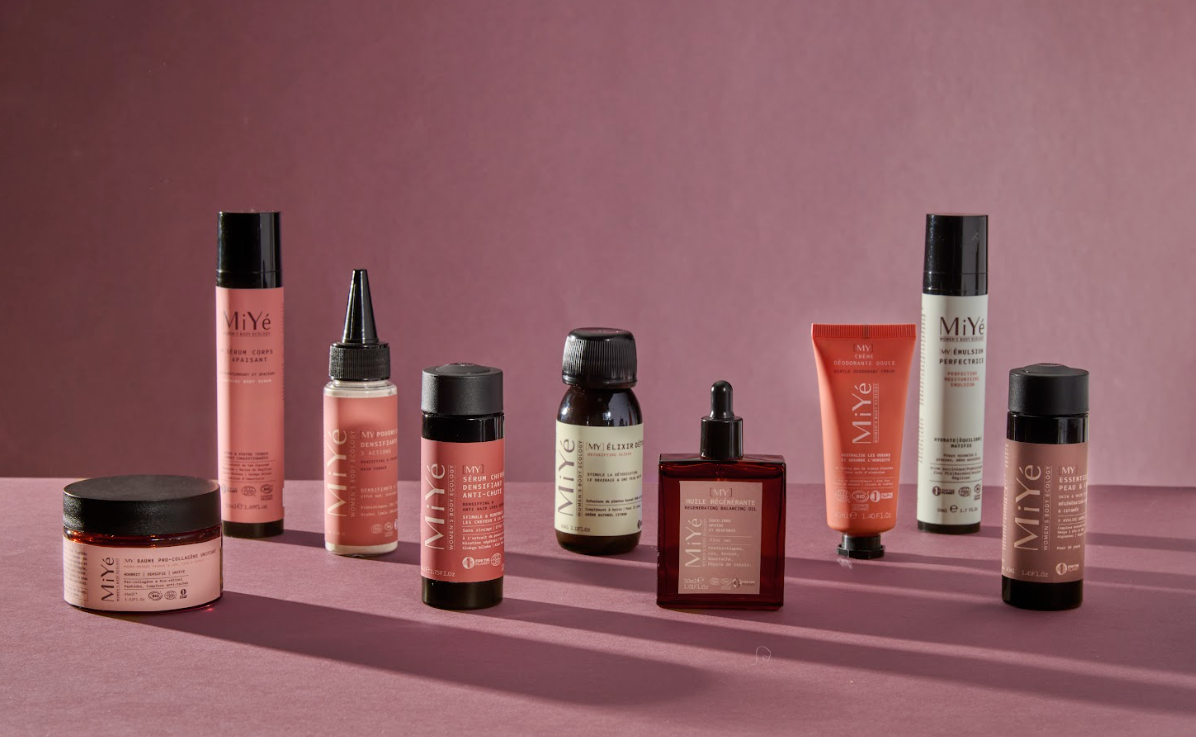
At MiYé, we are convinced that the future of skincare lies in cosmetics that are more respectful of the living world. Cosmetics that do not seek to correct the skin at all costs, but to understand how it works in order to support it better.
This approach to skincare guides all MiYé formulations. Each product is developed according to the principles of biomimicry, in order to respect the skin's natural mechanisms and support its balance over the long term.
Our formulas combine carefully selected biomimetic actives designed to work in synergy and support the skin's essential functions: skin barrier protection, comfort, hydration, firmness and radiance.
Because performance should never come at the expense of skin balance. And because skin that is supported intelligently is often skin that ages better.
Discover our skincare collection dedicated to the skin.
All MiYé skincare products are compatible with pregnancy and breastfeeding and follow the principles of cosmetic biomimicry.
Sources:
- Kohno Y. et al. — Singlet oxygen quenching activity of squalene. *J Lipid Res*, 1995.
- Belkaid Y. & Tamoutounour S. — The influence of skin microorganisms on cutaneous immunity. *Nat Rev Immunol*, 2016.
- Fowler J. — Colloidal oatmeal formulations and the treatment of atopic dermatitis. *J Drugs Dermatol*, 2012.
- Chamlin S.L. et al. — Ceramide-dominant barrier repair lipids alleviate childhood atopic dermatitis. Journal of the American Academy of Dermatology, 2002.
- Zasada M. & Budzisz E. — Retinoids: active molecules influencing skin structure formation in cosmetic and dermatological treatments. *Postepy Dermatol Alergol*, 2019.

![[MY] PRO-COLLAGEN UNIFYING BALM](http://www.miye.care/cdn/shop/files/Visuels_FP_baume_pro_1.png?v=1784637202&width=1875)
![[MY] DUO COLLAGÈNE IN & OUT](http://www.miye.care/cdn/shop/files/EOPA_x_Baume_195f6e87-9e83-4243-aa75-2346daa1cea2.png?v=1784638323&width=1875)
![[MY] ESSENTIALS BONES, SKIN & JOINTS](http://www.miye.care/cdn/shop/files/1_82157749-d687-4d44-9eb8-3cdec6cb929a.png?v=1782986916&width=1875)
![[MY] DUO DENSITE](http://www.miye.care/cdn/shop/files/EOPA_x_EPC_ff26eb25-c064-4e8a-85c3-a415d23dd353.png?v=1784638323&width=1875)
Share:
Beyond Collagen: How to Help Skin Restart Its Regeneration?
Native 3rd Generation Collagen: More Than a Collagen, a Complete Biological Matrix