




SUMMARY
- What does this change for you in practice?
- Why MiYé chose Ovomet® and Ovoderm®
- How does this collagen work day to day?
- Proven efficacy: the numbers speak for themselves
- At menopause: why target bones, skin and joints together
- Our recommendation: get your bone density checked
- Adding 3rd-generation collagen to your routine
- Why this collagen comes from eggshell membrane
- FAQ
- Scientific sources


Key takeaways
3rd-generation collagen is a native, intact matrix sourced from eggshell membrane, as opposed to chemically hydrolysed collagen peptides
Its composition naturally combines type I/V/X collagen, elastin, hyaluronic acid, glucosamine, chondroitin and more than 400 bioactive proteins [1]
Its mechanism relies on stimulating the body's own production: the Pro-Hyp dipeptide activates fibroblasts, alongside a prebiotic action on the gut microbiota
The studied dose is 300mg per day: studies report joint improvements from day 5 [1], skin changes after 8 to 12 weeks [5], and bone effects over 3 to 6 months [6]
Cofactors and lifestyle remain essential: vitamin C, zinc, calcium, vitamins D3 and K2, sleep, movement and hydration support its action
At 45, you may notice your skin feels less firm. Your joints crack slightly as you walk down the stairs. Your bones seem more fragile. You know these three signals, and they rarely occur in isolation.
The good news? You do not need to swallow handfuls of marine collagen to support your body. A new-generation collagen, sourced from eggshell membrane, works differently. And far more effectively. At just 300mg per day [1], it activates your tissues' internal regeneration mechanisms.
But what makes it truly effective is not only that it comes from a natural, complete source. It is its composition: it does not contain collagen alone. It also contains elastin, hyaluronic acid, glucosamine, chondroitin, and more than 400 bioactive proteins [1]. It is an intact biological matrix, not an isolated, chemically fragmented peptide.
What does this change for you in practice?
What this 3rd-generation collagen really contains
To understand why this collagen produces different results, let's start with what it contains.
Eggshell membrane (Ovomet®/Ovoderm®) is not a fragmented peptide. It is an intact and complete biological matrix that naturally contains:
-
Type I, V and X collagen (22% minimum guaranteed) [1]: the three essential types for skin, tendons and joints
-
Elastin (25% minimum guaranteed) [1]: the protein that gives your skin its suppleness
-
Hyaluronic acid (3% minimum guaranteed) [1]: the molecule that locks in cellular hydration
-
Naturally occurring glucosamine and chondroitin [1]: found in cartilage, but here working in synergy with the whole matrix
-
More than 400 bioactive proteins identified by proteomic analysis [1]
That is the structural difference. An isolated marine collagen is like drinking a glass of water. This native matrix is like drinking a rich broth. All the nutrients work together, and it is this synergy that produces the effect.
Conventional collagen vs. native collagen: two radically different approaches
Before going further, it is important to clear up a common confusion: not all collagens are created equal.
Conventional hydrolysed collagen: chemical fragmentation
You have probably heard of marine or bovine collagen. These collagens are obtained through chemical hydrolysis, a forced fragmentation of native collagen into small peptides, which are supposed to be easier to digest.
The problem is biochemical: after ingesting 9 to 10 grams of hydrolysed marine collagen, the concentration of bioactive peptides in your blood only reaches 20 to 60 nanomoles per millilitre [2], whereas the efficacy threshold measured in the laboratory to stimulate your fibroblasts (the collagen-producing cells) is 200 nanomoles [2].
In other words: even at 10g per day, you only absorb 25% of the actual threshold required. And this effect fades quickly: the peptide is cleared within 4 to 6 hours [2]. This is why clinical studies require 8 to 12 weeks at a daily dose of 5 to 10g to observe results. Some brands include just 2.5 to 5g, which is insufficient according to the biological data.
Native collagen: the intact approach
Eggshell membrane is not hydrolysed. It is a native, intact, naturally complete biological matrix.
Because it has not been chemically fragmented, it retains its three-dimensional structure and all its accessory molecules (elastin, hyaluronic acid, glucosamine, and more). These molecules do not work in isolation: they work in synergy.
At just 300mg, this collagen produces results comparable to 10g of hydrolysed collagen. This difference exists because the mechanism of absorption and action is fundamentally different, not because one product is superior on principle, but because the biochemistry demonstrates it.
Why native type I collagen outperforms type II
Eggshell membrane mainly contains type I collagen, whereas many marine supplements offer type II.
Type I collagen contains 6% carbohydrates [3], compared with 26% for type II. Carbohydrates interfere negatively with digestion and absorption. After digestion of type I collagen, 95% of the absorbed peptides are bioactive Pro-Hyp dipeptides [3], compared with only 70% for type II.
This difference in biochemical efficiency is measurable and significant.
Why MiYé chose Ovomet® and Ovoderm®
You may be wondering: why this collagen specifically? Because the clinical data justifies it.
Measurable clinical results from day 5
Studies on Ovomet®/Ovoderm® show noticeable improvements from day 5 on the joints (47% reduction in pain) [1]. These results come faster than those observed with other available native collagens.
A complete composition
300mg of Ovomet®/Ovoderm® naturally contains 22% type I/V/X collagen + 25% elastin + 3% hyaluronic acid + glucosamine + chondroitin + 400+ bioactive proteins [1]. It is a complete matrix, structurally different from an isolated combination of peptides.
Superior absorption thanks to type I
Ovomet®/Ovoderm® is rich in type I collagen (6% carbohydrates) [3], which means that 95% of the absorbed peptides are bioactive Pro-Hyp dipeptides [3]. This is a biologically demonstrated efficiency advantage.
An ethical and sustainable source [1]
Unlike marine or bovine collagens, Ovomet®/Ovoderm® comes from eggshell membranes, a natural zero-waste by-product.
How does this collagen work day to day?
You may think that ingested collagen travels directly to where you need it: your skin, your joints, your bones. In reality, the mechanism is different.
3rd-generation collagen works through adaptive endogenous stimulation: it does not replace collagen, it signals your body to produce more of it.
The Pro-Hyp dipeptide: the key mechanism
When you ingest collagen from eggshell membrane, your digestive system releases amino acids and bioactive peptides. The most active of these is the Pro-Hyp dipeptide (proline-hydroxyproline).
Here is what happens in practice.
Step 1: massive absorption
After digestion of type I collagen (the one in eggshell membrane), 95% of the absorbed peptides are Pro-Hyp dipeptides [3], compared with only 70% for type II collagen. This difference in composition explains why this collagen produces faster results.
Step 2: fibroblast activation
These dipeptides circulate in your blood and directly activate your fibroblasts. These are the cells that produce collagen, elastin and hyaluronic acid.
In practice:
-
Fibroblasts multiply faster (mitogenic increase)
-
Each fibroblast produces more collagen and hyaluronic acid
-
At the same time, the enzymes that break down collagen (collagenase, elastase) are slowed down
Step 3: natural adaptive targeting
The fibroblasts located in your skin will produce type I collagen (the one it needs), while those in your cartilage will produce type II collagen. Your body directs the signal according to the local context. This is endogenous adaptation, not mechanical redistribution.
Dual action: digestible + prebiotic
3rd-generation collagen acts on two fronts simultaneously.
Digestible fraction (90–100% absorption)
It directly stimulates the body's own synthesis of collagen, elastin and hyaluronic acid, while inhibiting their breakdown.
Non-digestible fraction (50%)
It acts as a prebiotic. It feeds the good bacteria in your gut microbiota, rebalances your flora and reduces low-grade systemic inflammation. This silent chronic inflammation is often at the root of chronic joint discomfort and accelerated ageing.
This is why a hydrolysed collagen alone, even at 10g, only does half the job. It provides collagen, but does not create the conditions for its regeneration. This native collagen activates endogenous regeneration and rebalances your microbiota at the same time.
Proven efficacy: the numbers speak for themselves
The scientific studies on Ovomet®/Ovoderm® all use 300mg per day [1]. Exactly the dose contained in [MY] Essentials Bones, Skin & Joints.
On joints: results in 5 days
Clinical trials measured joint pain and stiffness in people with mild to moderate discomfort [1]:
-
By day 5: pain reduced by 47% vs placebo [1]
-
By day 30: stiffness reduced by 68% vs placebo [1]
-
By day 50: tendon elasticity improved by +37 to +46% vs placebo [1]
These results come faster than with conventional collagens, which generally require 8 to 12 weeks for comparable improvements.
On the skin: visible after 8–12 weeks
The women who took part in the skin studies observed [5]:
-
Elasticity: +15 to +28% vs placebo [5]
-
Firmness: +14 to +21% vs placebo [5]
-
Collagen density: +15% vs placebo [5]
-
Elastin density: +30% vs placebo [5]
These improvements are measurable through imaging and biopsies. An increase in collagen density corresponds to a real structural improvement, not a subjective perception.
On bones: prevention and maintenance
Native collagen supports bone density, particularly when combined with essential cofactors (calcium, vitamins D3 and K2, zinc). Clinical studies have shown that this combination stabilises bone density in postmenopausal women [6] and reduces markers of bone breakdown.
At menopause: why target bones, skin and joints together
You may be asking yourself: why target bones, skin and joints at the same time? Isn't that an oversimplification?
No. It is the very biology of menopause.
As oestrogen levels gradually decline, three phenomena occur in parallel, connected by the same hormonal cause.
Bone density drops by up to 20% [6] in the 5 to 7 years following menopause. Skin collagen production drops by 30% [5] within the first 5 years. Joint cartilage gradually thins, deprived of its hormonal protection.
These three losses are not independent. They are interconnected by the hormone. And they accelerate together.
These three losses are not independent. They are interconnected by the hormone. And they accelerate together, a phenomenon detailed in What is the link between menopause and osteoporosis?
A conventional collagen forces you to choose: skin OR joints OR bones. 3rd-generation collagen acts on all three simultaneously, thanks to its multimodal composition (type I/V/X collagens, elastin, hyaluronic acid, glucosamine).
This is why [MY] Essentials Bones, Skin & Joints combines 300mg of Ovomet®/Ovoderm® with targeted cofactors: calcium citrate + vitamins D3 & K2 for the bones, zinc and vitamin C for the skin, Bonolive® and Coenzyme Q10 for the joints.
Our recommendation: get your bone density checked
Before starting this supplement, or alongside it, we strongly recommend having your bone density assessed if you are menopausal or postmenopausal, especially if you have a family history of osteoporosis.
Menopause and osteoporosis: when should you have a bone density scan (DEXA)?
Bone densitometry is the reference examination for measuring bone mineral density [6]. This non-invasive, painless examination allows you to assess your bone health before starting supplementation, detect early bone loss and monitor the real effect of native collagen combined with its cofactors on your bone density in the months that follow.
Who should have one?
This recommendation applies particularly to women aged 50 and over, or postmenopausal women. It is also strongly suggested for women with risk factors: a sedentary lifestyle, a nutrient-poor diet, early menopause, or a family history of osteoporosis. If you want to make the most of your support during this critical phase, bone densitometry becomes a valuable tool.
How does it work?
You see your GP or a rheumatologist, who will prescribe the examination. Bone densitometry (DEXA) measures your T-score, which indicates your bone density compared with that of a young woman. The examination takes around 15 minutes, with no injection and no significant radiation.
Adding 3rd-generation collagen to your routine
Here is an important point: collagen alone is not enough.
The clinical studies that demonstrated the efficacy of 3rd-generation collagen at 300mg always combined it with essential cofactors to amplify its action.
The essential cofactors
Vitamin C [8]: an essential cofactor for collagen synthesis. Without it, even 10g of collagen is not enough to trigger production.
Zinc [1] (in bisglycinate form for better absorption): essential for the renewal of the collagen matrix and bone mineralisation.
Calcium citrate + vitamins D3 & K2 [6]: the bone trio that directs calcium towards your bones, not your arteries. Vitamin K2 activates osteocalcin, a key protein in bone remodelling.
Coenzyme Q10: protects your chondrocytes (cartilage cells) from oxidative stress and supports their capacity for regeneration.
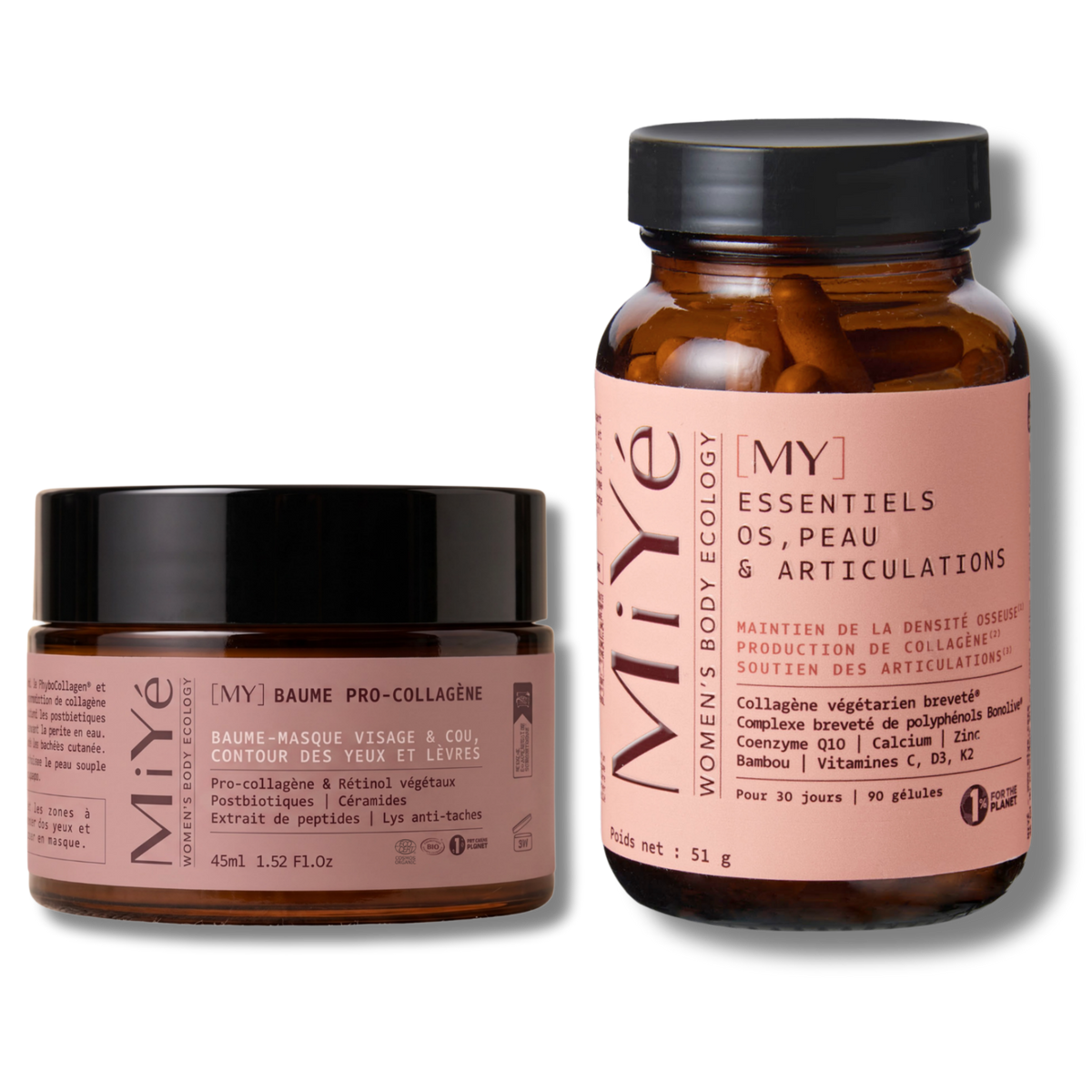
This is exactly the logic behind [MY] Essentials Bones, Skin & Joints: 300mg of Ovomet®/Ovoderm® combined with all the clinically proven cofactors, plus two additional patented actives (Bonolive® for bone formation, ceramides for the skin barrier).
Taken alone, a marine collagen remains insufficient. Combined with the right cofactors, 300mg delivers a complete action.
Dosage and duration
Take 3 capsules per day with a meal, preferably in the morning or at midday. Results on the joints may be noticeable from 5 to 7 days [1], but the full transformation takes 8 to 12 weeks for the skin [5] and 3 to 6 months for bone density [6]. Bone remodelling is a slow biological process.
Lifestyle: the foundation
A collagen, even a complete one, works better within a consistent, healthy lifestyle. For optimal results:
-
Enough sleep (7–9 hours per night): this is when your body repairs its tissues. (Learn more about sleep during menopause)
-
A diet rich in vitamin C and minerals [8]: broccoli, peppers, kiwi, sweet potato
-
Hydration (1.5 to 2 litres per day): water is the vehicle of cell regeneration
-
Regular movement (walking, gentle strength training, yoga): joints benefit from movement
-
Stress management: elevated cortisol interferes with collagen synthesis
3rd-generation collagen amplifies the effect of a healthy lifestyle. It is a synergy.
Why this collagen comes from eggshell membrane
This collagen comes from eggshell membranes, not from fish or cattle.
In practice, this means several things.
For your health
Eggshell membrane naturally contains the specific amino acids (proline, hydroxyproline, glycine) that your connective tissues need. The absence of carbohydrates (compared with marine type II collagen) improves digestibility and absorption by 22 to 27% [3].
For your digestion
No chemical hydrolysis fragments the native structure. Your gut recognises this matrix as real food and tolerates it better. No documented digestive side effects.
For your values
If you are looking for more ethical and sustainable ingredients, eggshell membrane uses a natural by-product of the food industry. Zero waste.
FAQ
What does '3rd generation' actually mean?
1st generation = conventional hydrolysed collagen (chemically fragmented). 2nd generation = combinations of collagen + isolated cofactors. 3rd generation = a complete native biological matrix (eggshell membrane) that contains all the components and all the cofactors within its natural structure, absorbed in synergy.
Why is this collagen more effective if there is less of it (300mg vs 10g)?
Comparative clinical studies measure functional results, not quantity [1]. At 300mg, this native collagen produces improvements (joints, skin) within 5 to 12 weeks, whereas 10g of a hydrolysed collagen is needed to achieve similar results. The difference lies in the structural composition (built-in elastin, hyaluronic acid and glucosamine) working in synergy [1].
I have been taking a conventional collagen for 3 months with no results. Should I switch?
If you see no change after 3 months, it is probably because the dose is insufficient (2.5 to 5g) or the cofactors are missing. Native collagen acts faster and at a lower dose. It may be time to give it a try.
Is it compatible with my hormonal contraception?
Yes. [MY] Essentials Bones, Skin & Joints is compatible with all types of hormonal contraception. The actives do not disrupt the hormonal cycle.
How long before I see results?
On the joints, some women report improvements from 5 to 7 days [1]. On the skin, allow 8 to 12 weeks [5] for measurable visibility. On the bones, the timeline is longer (3 to 6 months) [6] because bone remodelling is a slow biological process. Results also depend on your lifestyle and the presence of the cofactors.
Scientific sources
- [1] Composition and mechanisms of action of native collagen from eggshell membrane — Eggnovo (Laboratory). Certified Ovomet® and Ovoderm® data
- [2] Identification of food-derived collagen peptides in human blood after oral ingestion of gelatin hydrolysates — Iwai et al. (2005). J. Agric. Food Chem., 53(16)
- [3] Plasma bioavailability of the Pro-Hyp dipeptide after collagen ingestion — Ohara et al. (2007). J. Agric. Food Chem., 55(4), 1291–1297
- [4] Glycosylation differences between type I and type II collagens and their impact on fibril formation — Notbohm et al. (1999). Journal of Biological Chemistry, 274(13), 8988–8992
- [5] Skin elasticity and elastin in menopausal women — Lasfar et al. (2025). Frontiers in Nutrition, 12, 1670194
- [6] Bone density and osteocalcin in postmenopausal women — Filip et al. (2015). The Journal of Nutrition, Health & Aging, 19(1), 77–86
- [7] Joint pain and knee mobility — Horcajada et al. (2022). Therapeutic Advances in Musculoskeletal Disease, 14, 1759720X211070205
- [8] Vitamin C as an essential cofactor in skin collagen synthesis — Pullar et al. (2017). Nutrients, 9(8), 866
- [9] Oestrogen-related decline in skin ceramides in menopausal women — Kendall et al. (2022). Scientific Reports, 12, 1329
- [10] Organic silica and type I collagen synthesis — Reffitt et al. (2003). Bone, 32(2), 127–135

![[MY] Essentiels os peau et articulations, à l'achat individuel](http://www.miye.care/cdn/shop/files/1_82157749-d687-4d44-9eb8-3cdec6cb929a.png?v=1782986916&width=1875)
Share:
Beyond Collagen: How to Help Skin Restart Its Regeneration?
Biomimetic actives: what if your skin already knew the best routine?