






SUMMARY
- Insomnia at menopause: what natural solutions can help restore sleep?
- What causes insomnia at menopause?
- The age-related decline in melatonin: a factor too often overlooked
- How to recognise insomnia linked to menopause?
- Plants for sleep disturbances at menopause
- Which plant for which sleep profile?
- Magnesium, melatonin and nutrients: sleep allies at menopause
- Lifestyle habits and bedtime routine: the fundamentals for better sleep at menopause
- Sophrology, cardiac coherence breathing, meditation: mind-body approaches for insomnia
- Food supplements: how to choose well for better sleep at menopause?


Key takeaways
Insomnia at menopause is multifactorial: declining oestrogen, falling progesterone, reduced melatonin secretion, nocturnal hot flushes and anxiety.
There are 3 distinct profiles, each calling for different solutions:
- difficulty falling asleep,
- nocturnal awakenings,
- early morning waking.
The best-documented plants for sleep at menopause are valerian, passionflower, hops, lemon balm, chamomile, lavender and hawthorn. They can be consumed as herbal teas, essential oils or food supplements.
Magnesium bisglycinate (the most bioavailable form) supports melatonin synthesis and nervous and muscular relaxation.
A short course of melatonin supplementation (1-2 mg) can help reduce time to sleep onset; this should be overseen by a healthcare professional.
A consistent evening routine is the essential foundation for all these solutions to reach their full potential.
Insomnia at menopause: what natural solutions can help restore sleep?
Menopause brings profound hormonal upheaval, of which sleep disturbances are one of the most frequent and most exhausting consequences. Difficulty falling asleep, repeated nocturnal awakenings, non-restorative sleep... These disruptions affect the vast majority of women from perimenopause onwards, and can persist long into postmenopause. The good news: well-documented natural solutions exist to finally restore deep, restorative sleep. Phytotherapy, essential nutrients, evening routines: this article sets out concrete, reliable answers.
What causes insomnia at menopause?
Insomnia at menopause is rarely due to a single cause: it most often results from a combination of hormonal, physical and psychological factors.
The decline in oestrogen and the fall in progesterone, hormones that naturally promote sleep, profoundly disrupts rest cycles. This hormonal imbalance is also responsible for hot flushes and night sweats, which cause sudden awakenings in the middle of the night and make falling back to sleep difficult.
Added to this are often underestimated psychological factors: anxiety, rumination and mood swings, themselves linked to hormonal fluctuations, maintain a state of vigilance incompatible with deep sleep. Certain associated disorders, such as restless leg syndrome or sleep apnoea, also become more frequent after the age of 50, further worsening sleep quality.
These mechanisms are part of a broader hormonal picture, some aspects of which remain poorly identified: consult our article on the 35 lesser-known symptoms of menopause.
The age-related decline in melatonin: a factor too often overlooked
What is rarely mentioned in articles on sleep disturbances at menopause is the progressive decline in melatonin secretion that comes with age.
Melatonin is the central hormone regulating sleep cycles. Produced by the pineal gland from tryptophan, via serotonin, it naturally rises at nightfall to send the body the signal to sleep. Yet this melatonin production declines significantly from the age of fifty onwards. Sleep cycles become more fragmented, sleep onset is prolonged, nocturnal awakenings multiply, independently of other menopause symptoms.
This mechanism explains why acting solely on hot flushes is sometimes insufficient to restore satisfactory sleep quality: the disruption also has a neurobiological origin. Understanding this means giving yourself the means to act on every lever.
How to recognise insomnia linked to menopause?
Not all sleep disturbances at menopause are the same. Identifying your profile is a key step in finding the solutions best suited to your situation.
The 3 insomnia profiles at menopause
1. Sleep onset insomnia
The sleep onset phase extends beyond 30 minutes despite feeling tired. This profile is often associated with anxiety, intrusive thoughts and a state of hypervigilance. The decline in progesterone, which has a naturally sedative effect, is frequently responsible during perimenopause.
2. Sleep maintenance insomnia (nocturnal awakenings)
Sleep onset occurs without difficulty, but one or more nocturnal awakenings occur in the middle of the night. These are often triggered by a nocturnal hot flush or night sweats. This is the most common insomnia profile at menopause. Falling back to sleep can take anywhere from 30 minutes to several hours.
3. Early morning waking
Waking occurs spontaneously 2 to 3 hours before the desired time, with an inability to fall back to sleep. This profile is often linked to an early rise in cortisol or an anxiety component, which is common during periods of marked hormonal imbalance.
Plants for sleep disturbances at menopause

Phytotherapy offers several well-documented natural options for improving sleep quality at menopause. This selection focuses exclusively on plants whose action targets sleep onset, nocturnal awakenings and overall sleep quality, to be distinguished from plants acting on hot flushes or hormonal balance, which are covered in a separate article.
Consult a healthcare professional before any supplementation, particularly if you are taking medication.
Valerian: a well-documented plant for sleep onset

Valerian is one of the best-documented plants for promoting rapid sleep onset and improving sleep quality. It acts by increasing GABA levels, an inhibitory neurotransmitter that calms the central nervous system. It can be taken in capsules, mother tincture or infusion, approximately one hour before bedtime. At recommended doses, valerian is generally well tolerated and is not associated with a risk of dependency.
Passionflower: the ally for anxiety-related insomnia

Passionflower helps to ease the effects of stress and calm mental overactivity, thereby facilitating sleep onset. It is particularly indicated for sleep onset insomnia linked to anxiety and nocturnal rumination. Combined with valerian, it enhances the latter's sedative effect.
Lemon balm: nervous and digestive relaxation

Lemon balm soothes the nervous system and supports digestive comfort, two factors that directly influence sleep quality. It is particularly suited to insomnia linked to mild nervousness or an evening meal that is hard to digest. Take as an infusion or in capsules before bedtime.
Chamomile: gentle relaxation

Chamomile promotes relaxation through apigenin, a flavonoid that interacts with GABA receptors in the brain. It is suited to mild insomnia profiles, difficulty falling asleep without marked anxiety, and can easily be consumed as an evening infusion.
Lavender: sleep-promoting effect through olfaction

The active compounds in lavender support a state of relaxation conducive to sleep and contribute to serotonin secretion, a precursor of melatonin. It is used primarily as an essential oil, diffused in the bedroom or applied diluted to the wrists and solar plexus before sleep.
Hops: the ally for nocturnal awakenings

Hops has marked sedative properties and proves particularly effective in reducing nocturnal awakenings. Combined with valerian, it enhances its effect. It is one of the most indicated plants for sleep maintenance insomnia at menopause.
Hawthorn: deep sleep and nocturnal palpitations

Hawthorn helps to stabilise heart rhythm and support cardiovascular comfort. It promotes deeper, more regular sleep, and is particularly suited to women whose awakenings are accompanied by palpitations or a sense of internal agitation that is difficult to calm.
Which plant for which sleep profile?
Plant |
Difficulty falling asleep |
Nocturnal awakenings |
Anxiety / Stress |
Nervous tension |
Nocturnal palpitations |
Valerian |
✓✓✓ |
✓✓ |
✓✓ |
✓✓ |
- |
Passionflower |
✓✓ |
✓✓ |
✓✓✓ |
✓✓ |
- |
Lemon balm |
✓✓ |
✓✓ |
✓ |
✓✓ |
- |
Chamomile |
✓✓ |
✓ |
✓✓ |
✓ |
- |
Lavender |
✓✓ |
✓ |
✓✓ |
✓✓ |
- |
Hops |
✓✓ |
✓✓✓ |
✓ |
✓✓ |
- |
Hawthorn |
✓ |
✓✓ |
✓✓ |
✓ |
✓✓✓ |
✓ mild action, ✓✓ moderate action, ✓✓✓ marked action.
These indications are provided for informational purposes only and do not replace medical advice.
Magnesium, melatonin and nutrients: sleep allies at menopause
Magnesium: an essential cofactor for melatonin synthesis
Magnesium plays a central role in melatonin production: it is an indispensable cofactor for the conversion of tryptophan into serotonin, which is itself a precursor of melatonin. Without sufficient magnesium intake, the entire synthesis chain of this sleep hormone operates below capacity.
Beyond its role in sleep cycles, magnesium contributes to muscle relaxation, nervous system regulation and reduced stress sensitivity, three levers directly linked to sleep quality at menopause.
Which form to choose? Magnesium bisglycinate is the form most readily absorbed by the body and best tolerated digestively. Unlike oxide or sulphate forms, it does not cause a laxative effect and penetrates cells effectively.
→ Find magnesium bisglycinate in our supplement dedicated to nervous balance and sleep quality.
Melatonin: understanding the decline and the benefits of supplementation
As mentioned above, melatonin secretion declines progressively with age, intensifying at menopause at the very moment when sleep cycles become most unstable.
Targeted supplementation can help reduce time to sleep onset. The EFSA (European Food Safety Authority) recognises the following health claim for a dose of 1 mg: "Melatonin contributes to the reduction of time taken to fall asleep." Some studies have also observed positive effects on reducing nocturnal awakenings at doses between 1 and 3 mg.
Precautions: a dose of 1 to 2 mg, taken 30 to 60 minutes before bedtime, is generally recommended for occasional use. Prolonged use or higher doses should be discussed with a healthcare professional. Melatonin is not recommended during pregnancy and may interact with certain treatments (anticoagulants and immunosuppressants in particular).
Foods to favour at dinner for better sleep
The evening meal directly influences melatonin synthesis and the nervous system's response. A few simple adjustments can improve sleep quality without any supplementation.
What to put on your plate in the evening:
- Foods rich in tryptophan (precursor of serotonin and melatonin): turkey, egg, banana, pumpkin seeds, dark chocolate
- Complex carbohydrates (brown rice, quinoa, sweet potato) which facilitate the transport of tryptophan to the brain
- Omega-3 (oily fish, walnuts, hemp seeds) which support emotional regulation and brain function
To avoid after 6pm:
- Alcohol (disrupts deep sleep despite its initially deceptive sedative effect)
- Fast sugars and overly rich meals (destabilise blood sugar levels and fragment sleep cycles)
- Late meals, within the 2 hours preceding bedtime
- Caffeine and all stimulants (black tea, cola, guarana) after 2pm
Lifestyle habits and bedtime routine: the fundamentals for better sleep at menopause
Natural solutions are all the more effective when they form part of a consistent evening routine. Here is a typical evening schedule designed for women in perimenopause and menopause, to progressively prepare the body and mind for restorative sleep.
From 6pm: Laying the foundations
- Finish physical activity before 7pm: late-evening exercise stimulates cortisol and delays melatonin secretion
- Eat a light, balanced dinner, rich in tryptophan and complex carbohydrates
- Avoid coffee, tea, alcohol and fast sugars
Between 8pm and 9pm: The transition
- Progressively reduce screen exposure or activate a blue light filter: this light inhibits melatonin secretion
- Create a conducive atmosphere: dimmed lighting, soft music, reading, gentle stretching
- Take any supplements as appropriate (magnesium, plants, melatonin) approximately 1 hour before bedtime
At bedtime: The environment matters
- Keep the bedroom at a cool temperature (between 16 and 19°C), particularly beneficial for limiting the intensity of nocturnal hot flushes
- Favour breathable materials for bedding and nightwear (linen, cotton)
- Practise a few minutes of abdominal breathing or cardiac coherence breathing to lower heart rate and promote sleep onset
- Maintain regular bedtime and waking times, including at weekends
In the event of a nocturnal awakening
- Avoid checking the time or switching on the light (stimulates cortisol and delays falling back to sleep)
- Practise 4-7-8 breathing: inhale for 4 seconds, hold for 7 seconds, exhale for 8 seconds
- In the event of a nocturnal hot flush: keep a cool cloth nearby, gently ventilate without getting up completely
The information in this article is provided for educational purposes and does not replace medical advice. Our products are not intended for medical use. In cases of persistent sleep disturbances or an associated condition (sleep apnoea, restless leg syndrome), we recommend consulting your GP.
Sophrology, cardiac coherence breathing, meditation: mind-body approaches for insomnia
Beyond plants and nutrients, certain mind-body practices have shown documented results on sleep quality at menopause. Their common thread: acting on the autonomic nervous system to reduce the state of hypervigilance, the main obstacle to falling asleep or returning to sleep after a nocturnal awakening.
Cardiac coherence breathing 3·6·5: 5 minutes to calm the nervous system
Cardiac coherence breathing is a guided breathing technique that synchronises respiratory rhythm and heart rate, thereby activating the parasympathetic nervous system, the one that promotes rest and recovery. The 3·6·5 protocol is the simplest and most accessible:
- 3 sessions per day
- 6 breaths per minute (inhale for 5 seconds, exhale for 5 seconds)
- 5 minutes per session
Practised in the evening, approximately one hour before bedtime, it helps lower cortisol levels, reduce heart rate and prepare the body for sleep. Free apps, Respirelax, RespiCoach, make it easy to follow along for the first sessions.
Sophrology and mindfulness meditation
Mindfulness meditation, and in particular the MBSR (Mindfulness-Based Stress Reduction) protocol developed by Dr Jon Kabat-Zinn, has been the subject of several clinical studies in women experiencing sleep disturbances related to menopause. This research has shown significant improvements in sleep quality, reduced nocturnal anxiety and perceived wellbeing.
Sophrology combines progressive muscle relaxation, positive visualisation and controlled breathing. It is particularly suited to the sleep onset insomnia profile, where intrusive thoughts delay the transition to sleep. A guided session of 15 to 20 minutes before bedtime can encourage the letting-go that is necessary. Both practices can easily be integrated independently via apps or audio recordings, or with a trained professional.
CBT-I: a clinically validated behavioural approach
Cognitive behavioural therapy for insomnia (CBT-I) is recommended as the first-line approach by the French High Authority for Health (HAS) for managing chronic insomnia, before sleeping medication is considered. It demonstrates documented efficacy rates of 70 to 80% in people suffering from chronic insomnia, with long-lasting results that are superior to medication-based approaches over time.
It is based on several clinically validated techniques:
- Stimulus control: returning to bed only when genuinely sleepy, reserving the bed exclusively for sleep
- Sleep restriction: temporarily reducing time spent in bed to consolidate sleep cycles
- Cognitive restructuring: identifying and modifying anxiety-inducing thoughts around sleep ("I'm never going to fall back to sleep", "I'll be exhausted tomorrow")
- Sleep hygiene education: the fundamentals covered in the previous section
CBT-I can be undertaken with a psychologist specialising in sleep disorders, or via clinically validated digital programmes. If your sleep difficulties have persisted for more than three months despite natural approaches, it is the next step to consider with your GP.
Food supplements: how to choose well for better sleep at menopause?
Natural approaches are more effective when they combine several complementary levers. Here are the best-documented actives for supporting sleep quality at menopause:
- Magnesium bisglycinate: cofactor for melatonin synthesis, nervous and muscular relaxation, excellent digestive tolerance, the reference form for daily supplementation
- Vitamin B6: an indispensable cofactor in the conversion of tryptophan into serotonin and then melatonin. It reinforces the action of magnesium across this entire synthesis chain
- Lemon balm: soothes the nervous system and supports sleep onset, particularly in cases of mild nervousness or stress-related insomnia
- Ashwagandha: an adaptogenic plant for which several double-blind randomised clinical studies have shown significant improvements in sleep quality, time to sleep onset and recovery, both in healthy subjects and in people suffering from insomnia (Langade et al., 2021; Deshpande et al., 2020)
- Saffron: clinical studies have documented its positive effect on sleep quality and anxiety reduction at doses of standardised extracts. It is attracting growing interest in formulas dedicated to emotional balance and sleep
What to look for on a label:
- The form of magnesium: bisglycinate or malate, not oxide or marine-derived
- The presence of vitamin B6 as a cofactor
- Standardised extracts for plants, which guarantee a reproducible active concentration
- The absence of phytoestrogens (red clover, isoflavones) if you have a hormonal history
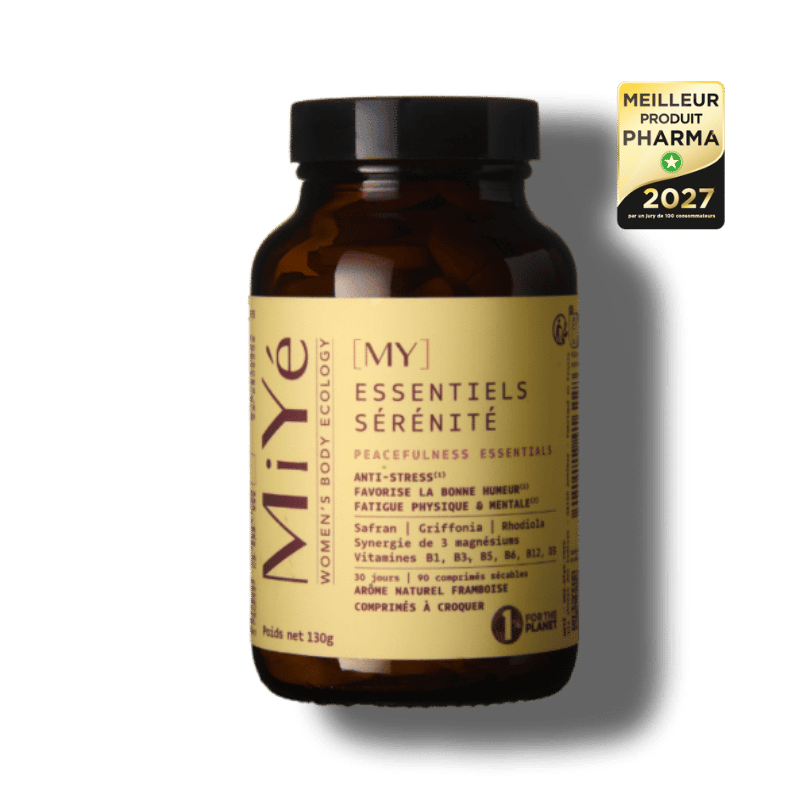
The MiYé choice: [MY] Essentiels Sérénité
[MY] Essentiels Sérénité combines a synergy of three complementary magnesium forms (bisglycinate, malate and citrate) with plants and vitamins selected for their action on nervous balance, sleep quality and everyday stress management.
Active ingredients:
- Saffron: for mood support,
- Griffonia: for sleep and preventing cravings,
- Magnesium bisglycinate, malate and citrate: for fatigue and nervous tension
Sources
- Haute Autorité de Santé (HAS), Management of chronic insomnia in adults: https://www.has-sante.fr
- Réseau Morphée, CBT-I, first-line approach: https://reseau-morphee.fr/le-sommeil-et-ses-troubles-informations/insomnies-apnees/insomnie/prise-charge-non-medicamenteuse-de-linsomnie
-
Minerva EBP, CBT-I and chronic insomnia (JAMA Psychiatry 2024 meta-analysis):
https://minerva-ebp.be/FR/Article/2390 -
Langade D. et al., Ashwagandha root extract on sleep in healthy volunteers and insomnia patients. J Ethnopharmacol. 2021:
PMID: 32818573 -
Deshpande A. et al., Effects of ashwagandha extract on sleep quality in healthy adults. Sleep Medicine. 2020:
PMID: 32540634 -
Université de Lorraine, Phytotherapy and menopause:
https://hal.univ-lorraine.fr/hal-01947172 -
Minerva EBP, Phytotherapy and menopause:
https://minerva-ebp.be/FR/Article/437 -
EFSA, Melatonin 1 mg health claim:
https://efsa.onlinelibrary.wiley.com/doi/10.2903/j.efsa.2015.4186

![Pilulier [MY] Essentiels équilibre féminin sur fond transparent](http://www.miye.care/cdn/shop/files/Visuels-shop-25.png?v=1747987949&width=800)
Share:
Matcha Vs Coffee : Differences between twice
What is good for hair ? : The best active ingredients